Showing posts with label Fundamentalism. Show all posts

Friday, February 22, 2013

The Christian Cases for Gay Marriage

This is part of a series of Essays from a Christian Perspective.

Wedding bells are ringin' in the chapel,
I hear the children laughing out with glee.
At home alone I hang my head in sorrow,
Wedding bells will never ring for me.

—"Wedding Bells," Lissie

(Before I get to my main purpose this week, I want to point out that it is now the Christian season of Lent, about which I have written a few things. I'm not going to reflect on the season again this year, but I do think that this guy has a particularly interesting perspective on the matter. [I'm a big fan of the sardonic someecards message at the top of the post.])

***

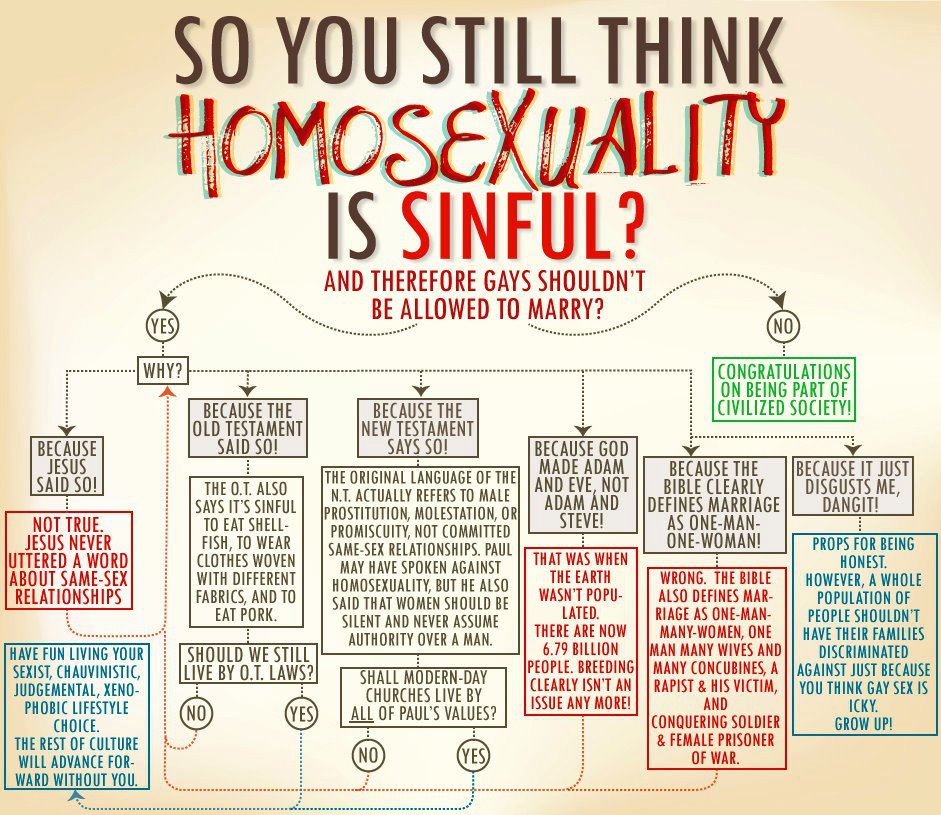
The other day, former Utah governor John Huntsman came out for gay marriage, in an op-ed called "Marriage Equality Is a Conservative Cause." Huntsman is a conservative I find easy to respect and admire, even as I disagree with him on many issues, so it was nice to find myself on the same side as him in an important ideological divide. But in his piece, Huntsman eschewed a case from the perspective of his faith, Mormonism, which is not by any means completely unthinkable. While I've written without much detail on the subject before, reading Huntsman's op-ed made me feel it was time to lay out why I think Christians should embrace gay marriage.


As in any protracted and difficult argument, there are actually a number of different cases for gay marriage and gay relationships within Christianity. I'm going to briefly outline the ones I think are most central. 


1. The Bible does not condemn homosexuality
An important starting point is addressing whether or not the Christian Bible condemns consensual homosexual relationships. There are a number of scholars and exegetes who argue that, in fact, it does not do so. There are a limited number of places throughout the Bible that appear to condemn homosexual practice, but there are strong arguments to be made in each case that something else is being condemned—a failure to practice hospitality, sexual slavery, cultic prostitution, etc. Here is a pretty readable argument taking on the passages in question, and here is a ludicrously detailed one for those who want to really dive into the subject.

(There is another approach to the subject, which is a bit more appealing to me, but more troubling for people with a strong belief in Biblical inerrancy, as it requires you to accept that there are some things in the Bible that are wrong. [Because I recognize that the Bible has historical and scientific inaccuracies, I abandoned this idea some time ago, but there are a number of Christians who have not.] The argument for gay marriage here goes like this: there are parts of the Bible that approve of practices that modern Christians and most people in general find abhorrent, e.g., slavery, but these attitudes are a reflection of ancient cultural norms, not of God's will for human life. Instead of pointing to the few passages that condemn homosexual practice, we should recognize that they are the result of cultural prejudice, and seek to understand homosexuality as a legitimate part of God's creation. This argument is expressed much more eloquently here.)

2. Relating science, Christianity, and homosexuality
Another case can be made by asserting that Christianity (or Religion in general) is not, as is often assumed, contradictory to or mutually exclusive with Science, but that the two are complementary, and should inform each other. Thus, one can look for scientific evidence to inform Christian thought on the matter: whether homosexuality is a naturally occurring phenomenon, whether homosexual relationships can be psychologically healthy and stable, and whether being raised in a family headed by people in a homosexual relationship is harmful to children. The research I've encountered on the subject has been favorable to the conclusion that homosexuality and homosexual relationships are a positive part of God's created order. Here is a link that includes scientific evidence among a range of Christian arguments in favor of gay relationships.

3. Jesus
The last case I want to mention is the simplest to articulate, though defending it is a little more complex. (I won't go into detail here). It goes like this: an incredibly key message of Jesus' ministry was to welcome and include people who had been cast out by his society. By rejecting and condemning homosexuals, making them into outcasts in the Christian community, Christians also reject the message of Christ. Here is a pretty readable argument from this perspective.


There are tons of other cases to be made in favor of gay marriage, but I think most of the specifically Christian ones fall into these three categories. I think together these Christian cases for gay marriage are pretty doggone convincing.

That said, unlike some folks on both sides of this line, I can respect people who hold the opposing view. The only caveat I make is that I can't respect well, hate, and if it's not clear that someone's opposition to gay marriage comes from a place of love for the people involved, then I tend to lose that respect pretty quickly.

Photo 1 source: http://www.flickr.com/photos/mlostracco/8123465348/
Photo 2 source: http://www.flickr.com/photos/fibonacciblue/5728223962/

Friday, December 21, 2012

Why I Am Not A Fundamentalist Christian

  This is part of a series of Essays from a Christian Perspective.

I've got that old time religion in my heart,
Way down inside.
I've got a new kind of feeling in my heart:
Rejoice, abide.
Nobody knows what it means to me,
Nobody knows but my Lord and me.

I received the following response from an item I posted on Facebook (about leaving fundamentalist Christianity without leaving behind everything good about it):
Let me begin by stating that I don't have a full knowledge of church history, and thus do not know when fundamentalism began. However, post-modern teachings, such as those by Rachel Held Evans, are far more recent. The problem that I have with this type of teaching is that it reads a post-modern world view into the Bible instead of allowing the Bible to speak for itself. Also, if by scientific advancement you are talking about creation, this is something I too struggle with. [...] See, I believe precisely the opposite of what you believe, and I would say that the post-modern views strike me as false. I would say that if the Bible doesn't mean what it says, then what does it mean? Can it mean whatever I want it to mean (because I can make it mean some pretty crazy things)? Who is the authority? I would say in a post-modern view, it would be society, and I think that is inherently wrong. Quick question as well: if fundamentalism doesn’t adhere "to age-old tradition and practice" what view does? Or should we even?
I pointed out in an earlier post that Christian fundamentalism, like all religious fundamentalism, is a new phenomenon. I referred my friend to this post, to which the above is partially a response.

My reasons for leaving behind Christian fundamentalism, and particularly Biblical literalism, are complex, and doing so was an important stage in my life. I wanted to share here my response to my friend: 
First, let me say thanks for engaging with me on this topic. It's important for me to figure out what I really think, and that's hard to do on my own without someone to disagree with. For this, I hope we can continue to speak in a friendly manner: these things are important, sure, but they are also mysterious, and perhaps ultimately the truth of the matter cannot be known in this life, so we should be forgiving and understanding with each other. (Not just you and me, but people on both sides of this issue in general.)
Okay, speechifying done. I'm going to try address the stuff in your post in the order it appears in to keep it all straight.
  1. "However, post-modern teachings, such as those by Rachel Held Evans, are far more recent." Post-modernism is recent; I don't have a problem with recent ways of interpreting the Bible. My problem with fundamentalism is that it claims to be the original, oldest, purest way of "doing" Christianity when it is actually quite new. Refusing to accept any non-literal interpretations of the Bible, which is the basic premise of Christian fundamentalism, is new. Christians have been trying to make sense of scripture in other ways for much longer than they have been relying on literal interpretation alone; see, for example, the Fourfold Sense of Scripture (about which you can find more here) that was already in operation over a thousand years ago. (This fourfold sense is basically what I mean when I talk about "age-old tradition and practice." For example, some great Christian thinkers from ages past used metaphorical and allegorical interpretation to understand Genesis. And yes, I think we should be trying to adhere to, or least engage with, such tradition and practice.)
  2. "The problem that I have with this type of teaching is that it reads a post-modern world view into the Bible, instead of allowing the Bible to speak for itself." My experience is that modern and post-modern Christian thought seeks to understand the context of scripture, to know what was going on in the world around the person writing the words. It then tries to use that to help understand scripture better; perhaps even to decide which portions of scripture are still applicable to our daily lives in their literal meaning, and which portions are applicable no longer. I see this process as the opposite of imposing a modern worldview on an ancient text: instead, we are trying to understand an ancient text and adapt it to the world we actually live in today (and that, I think, is really "letting the Bible speak for itself"). 
  3. "Also, if by scientific advancement you are talking about creation, this is something I too struggle with." Creationism was actually my starting point for rejecting fundamentalism. From a young age, I realized that either I had to utterly reject many of the findings of science, or start interpreting at least some of the Bible as not literally true. I was worried about this for a while, but I talked to my dad about it, and he pointed out that scripture can make more important points than "X happened," and in fact is usually doing so, so why should I be concerned? I don't care if God created everything in literally six days; what I care about is the other big ideas the creation story is very clearly telling me, though not in a literal list of items: God is in charge of everything and is in some strong sense its author and master; humans are special because of our relationship to God; we are charged with taking care of what God has made. I don't need to think that the creation story is historically accurate to think those things are true. And the story is a beautiful, memorable way to learn those truths. They would not benefit from just being written out in a list at the beginning of the Bible.
  4. "I would say that if the Bible doesn't mean what it says, then what does it mean? Can it mean whatever I want it to mean (because I can make it mean some pretty crazy things)." Here is how I view the Bible: the Bible is God's word. (Note: this is not a particularly post-modern view, if I understand correctly.) God has ultimate authority to determine what humans should and should not do, and God's main medium for telling us this is the Bible. But trying to hear God speak using only the literal meaning of the words is tricky. There are times when God speaks directly to people in the Bible and tells them what and what not to do: sometimes they are things we Christians think we should pay attention to (like the Ten Commandments) and others aren't (like how we should kill witchesthis is a clear case where "letting the Bible speak for itself" in a literal sense doesn't work and Christians don't do it). But for pretty much any other story, you have to do at least a little work to make it matter at all to you (who cares if God literally saved Daniel from the lions' den? No one, unless we do a little interpreting and say that we believe God will also save us from harm if we are faithful to God) That meaning is pretty obvious though, which is true of much of the Bible. I don't think, and most people don't, that you can just make up a meaning that you like and put it with a text. Who will buy it? The meaning has to make sense from reading the story, and from knowing its cultural and textual context. That said, there may be parts of the Bible that were intended for ancient people and are just not relevant to modern people (like, say, rules about hwo to treat your slaves). One of the big problems for modern believers is figuring out what those parts are.
  5. "Who is the authority?" When, in my own life, I combined number 3 (some of the Bible can't literally be true if the modern world is to make any sense) and number 4 (literal sense is less important in many, many cases than the meaning behind the story) I stopped seeing the Bible as needing to be literally true. So I turned to a way of thinking that says "let's try to get the meaning and richness out of it anyway." Like you, and pretty much every fundamentalist, I was worried about who was in charge of determining what those meanings were (and, as I mentioned above, whether there are parts of the Bible that just don't apply to our lives anymore). My answer is that the person in charge is, first, Godwe can trust God to help and guide us as we try to live in 2012 AD and not 2012 BCand second, the Church, the body of believers, praying, discerning, and communicating with each other, just as we have these last two millennia.
Arriving at these conclusions took a long time, a lot of personal reflection, and, especially, a great deal of reading. If I could recommend any book to read on the subject of there simply being more, as well as more important, meanings in the Bible than the literal sense, it would certainly be The Meaning in the Miracles, by Jeffrey John. It's a beautiful book.  


Friday, August 31, 2012

The Salvation Army: A Frustrating, Wonderful Church

This is part of a series of Essays from a Christian Perspective.

Joy, joy joy! There is joy in the Salvation Army!
Joy, joy, joy, 
In the Army of the Lord.  
—"Joy in the Salvation Army," William Pearson & William Bradbury 

Note: inspiration for this week's blog post came from two sources: my friend Julia, who asked me about my church, and the BBC show "Rev.," which is about a vicar in the Church of England and his struggles with, among other things, the idiosyncrasies of the modern Christian church—it's an awesome show!

I grew up attending church at the Salvation Army. It was a great place—and a great way—to grow up.

That the Salvation Army is a church surprises a lot of people: most folks in the States associate it with thrift stores, or social work, or perhaps disaster relief. So a pretty stable part of my childhood, and indeed my whole life, has been explaining that in addition to those ministries, the Salvation Army is indeed a denomination of the Christian faith. In the early years this was frustrating, but now it's as natural as breathing.

I was not big on tough questions, analysis, or challenging authority as a child, so I viewed the Salvation Army as a wholly benevolent and wonderful organization until I became an adult. These days, I still have a lot of good to say about it, but I also have a number of profound frustrations; some of them based on my personal preferences and beliefs, and a few that I see as objective problems with the church, regardless of my beliefs.  I thought it would be healthy for me to articulate both frustration and joy here. (Disclaimers: if you are a member of the Salvation Army, please take these criticisms constructively, because I love the Salvation Army and would never mock or insult it; if you are not a member of the Salvation Army, and are not familiar with it, please remember that these are simply my opinions, and not necessarily the whole truth on any of the issues at hand.)

I'll start with the criticisms and then get to the good stuff.
  • Bureaucracy: This one is common to most churches today, especially in the West, where various scandals and lawsuits have made red tape inevitable. (If you've got 30 minutes to spare, I highly recommend season 2 episode 1 of Rev. for an amusing angle on the subject.) But the Salvation Army is the place where I have the most direct exposure to church bureaucracy and where I am frustrated by it the most. In particular, many administrators seem to enjoy exercising their power by creating and enforcing rules for rules' sake. A case-by-case approach or one taking mitigating factors into account is rare. Example: I was teaching a class (on my own and the student's free time—not a scheduled course) to some students at the Salvation Army's seminary, and after a few months got hauled in to an administrator's office and reprimanded. My crime? I hadn't told any higher-ups that I was on campus teaching a class (...to my friends...on our free time). I was accused of "sneaking around" and violating various rules that I didn't know were rules. My students were also reprimanded.
  • Christian Fundamentalism: The Salvation Army as a whole is not a fundamentalist sect. But there is a strong trend toward and identification with fundamentalism among many of its laypeople and leaders. Fundamentalism is, in my understanding, a modern phenomenon. It is a way of reading scripture and practicing Christianity that is not, as it might claim, adhering to age-old tradition and practice, but rather by nature a reaction against modernism and therefore quite recent. Its focus on Biblical literalism, rejection of scientific advancement and reason, and frequently apocalyptic mindset strike me as both deeply troubling and thoroughly backward. Example: when I was waiting with family in the hospital while my mom was having surgery, the Salvation Army ministers waiting with us tried to strike up a conversation about how Obama was probably the Antichrist. (I was livid, but I walked it off.)
  • Social Conservatism: I identify as a left-leaning moderate (or a straightforward liberal; it depends on the day) politically. So I find conservative viewpoints to be frustrating, especially when they are backed by religion, which they often are in the Salvation Army, from pulpits or in Bible study or youth groups. That is not to say that conservative viewpoints are all wrong or incompatible with a right reading of scripture, just that I find them frustrating. That said, I do thoroughly disagree with the Salvation Army's conservative take on homosexuality, which you can read here. Go ahead and read it if you like; it's actually a very gentle, kind statement, to my eyes, not particularly harsh or judgmental. But it is based on a fairly narrow reading of scripture, and it makes little attempt to account for the fact that, if we are God's creations, then some of us are created homosexual. I will not go into all the reasons I disagree with the Salvation Army's position; my thoughts and those of many others on the subjects of homosexuality and traditional marriage are decently summarized (if somewhat playfully) here and here
  • Worship Style: I've discussed things like this before, so I won't dwell on it much. The Salvation Army has some very unique worship elements, but overall it's often very similar to many other "low church" settings: guitars, drums, words projected on a screen, PowerPoint sermons, and so forth. It is a style driven by the desire to attract people with the familiar, rather than a desire to connect worshipers with the body of believers past and present. (An episode of "Rev.," [season 1, episode 2] explores this issue; some great commentary on the episode can be found here.)
With all those things I find frustrating, you may ask, why do I bother associating with "the Army" (as we often call it) at all? 


Here, briefly, are some reasons: 
  • Love: The Salvation Army is full of wonderful people who love each other, God, and their neighbors. There's a reason I've grown into a fairly well-adjusted, kind, faithful person: I had a lot of really good examples to look to when I was growing up in the Army.
  • Social Justice: More than any church I've ever visited, been a part of, or read about, the Salvation Army views its primary mission as serving others, especially the poor, broken, and suffering. This, to my mind, is a fundamental element, if not the primary function, of the Church of Christ in the world (though it shames me to write it, as one who often neglects this duty). I'm proud of the Army for holding up this example to other churches and to the world.
  • Global Family: Salvationists (as we call ourselves), no matter where we are on the globe, feel connected to one another as part of the same church, in a way that I've rarely heard described in other churches. I've done a fair amount of travel, and whenever I visit a Salvation Army, be it in another state or another continent, I am instantly welcomed, and often I am already known. This is the universal experience of Salvationists. Perhaps it is because the church is so small—100,000 members in the U.S., 1,000,000 worldwide—but I think we welcome and befriend each other so readily because we know what the Army is about (loving one's neighbor, caring for others) and we trust that other Salvationists know it too.
I assure you there are other reasons to love the Salvation Army; these are the big three for me. I hope I have been able to communicate my care for this church adequately; I am frustrated by it because I love it. I do have high hopes for it in the future. 

Sources: 
Photo 1: http://commons.wikimedia.org/wiki/File:StampUSA1965SalvArmy.jpg 
Photo 2: http://commons.wikimedia.org/wiki/File:FEMA_-_38827_-_The_Salvation_Army_feeding_people_returning_to_Galveston_Island.jpg