Showing posts with label Lists of Cool Things. Show all posts

Monday, July 29, 2013

How to Buy a Book

Part of a series of Lists of Cool Things.

Aww yeah, look at those sweet, sweet books.
Words, words...
—"Words (Between the Lines of Age)," Neil Young

I buy a lot of books.

There are books everywhere in my apartment: on my desk, in piles on the floor next to my desk, scattered across the various tables and other surfaces in my living room, and (of course) sitting on my bookshelves (my current bookshelf count: 6).

Once, I organized a bookshelf by color.

And, while some of them are gifts or things I've found in free book boxes, I own most of my books because I bought them.

Like most people, I love buying new things. I love the feeling of satisfaction that comes with new ownership, the surge of joy I feel when I hand the cashier my money and the desired thing becomes mine. I love this feeling so much that I routinely forget how quickly it fades, and so I sometimes get stuck with a book that seemed great in the store (or on the internet) but which, in reality, I don't have for, I'm not actually that interested in, or just isn't going to make me happy for whatever other reason.

To try avoid the state of unhappy book ownership, I've developed some techniques to help me get through the process successfully whenever I get the urge to go book shopping:  

1. Go to a real bookstore. 

My go-to: the neighborhood used bookstore, Myopic Books.
  • This is a tradeoff: while I find it much easier to avoid actually buying something if I'm just browsing on the internet, it is much more likely that I'm going to find something that will actually make me happy if I'm browsing in meatspace. 
  • In a bookstore, I can pick up the actual object and check whether I enjoy its physical qualities before making a purchase (...yes, I smell books before buying. Also at other times).  Here, I can generally get a much stronger sense of whether the book will be something that I will actually enjoy owning than I would when buying electronically.  
  • Also, the experience of browsing for books in person is actually fun and enjoyable in a way that internet browsing just can't really match. 

2. Think about books that I already know I want.

Display tables like this one at the Sem Co-op are dangerous.
  • For me, the best book to own is one I've already read or, failing that, one that I definitely know I want to own for some reason. 
  • If I check a book out from the library and really enjoy reading it, I'll look for it at the bookstore and consider buying it, to read again and lend to friends.
  • If I can't think of or find a book that I've read and enjoyed already, I try to look for books written by authors I trust (like Alastair Reynolds or Patrick O'Brian) or on subjects I know I'm passionate about (like Biblical scholarship or linguistics). 
  • I also try to look for books that friends or written reviews have recommended.

3. Sit down and read.

I wish more bookstores had places to do this.
  • Whether I was able to comply with 2 or especially if I wasn't (sometimes, a book just catches my eye and I just want it, okay?), I take a moment to read parts of the book, while sitting if at all possible.
  • I like to read the first page and then skip to page 99, just to get a feel for the quality of the language  and whether I'm really going to enjoy it, both at the start and after the real meat of the book has begun. 
  • Contrarily, I never read the blurb on a book's back cover or dust jacket if I can help it. Book blurbs can be fine, but they often give away major plot points or distort the actual essence of the book. If I don't know enough about the book to feel comfortable buying it yet, I'll skim the introduction if there is one; blurbs are a last resort for me.
  • While I'm doing this, I also check the physical quality of the book itself, especially if I'm buying used (and I usually am). Is the cover ripped? Pages stained? Can I live with any physical defects the book may have, or is there something that's going to actively decrease my enjoyment of the book itself? 

4. Ask a few final questions. 

These may include "How do I get out of here?"
  • My dad recently shared with me how he sees the process of starting a new book: it's a matter of trusting yourself to the author's care, giving yourself over to their power for a time. The wrong book can waste your time, bore you, or leave a bad taste in your mouth. When buying a new book, he needs to take a moment to consider that hours of his life will be spent in the author's care, so he needs to do everything he can to discern whether the author is trustworthy. 
  • My final book-buying thoughts tend in a slightly different direction; before buying, I try to ask: 
    • Do I have the time to give to this book, or will it languish on a shelf for five years after I buy it because it won't ever fit into my schedule? 
    • Do I have a good reason to own this (will I read it multiple times? will I lend it out?) or am I just in the mood to buy something? 
    • Can I pay for this without feeling guilty about it?

5. Read my purchase as soon as possible.

Yeah, read that book, past self!
  • I find that if I don't read a book pretty soon after purchasing it, it often won't get read for years. I have the bad habit of buying new books while unread ones sit on my shelves. 
  • I often get distracted by something else on my reading list if I don't read a book soon after purchase. It's best to read books right away for another reason, though: there's always a chance I'll lose interest in the book altogether, for one reason or another, later on down the line. Best to get the joy I can out of my books before that happens!

Good books are among my life's chief joys. I love finding a new piece of fiction that presents me with a fully realized world and shapes the way I think about my own world. And I love working through a good non-fiction text, learning things, teasing out arguments, and debating whether I agree with the book's thesis. I feel like these joys are my reward for putting the real work into acquiring a new book, which is why creating a good process has been so important and useful to me. It doesn't work every time, and I don't always remember to follow it, but when it does work, the results are like nothing else I know.


Photo sources:
Photo 1: http://www.flickr.com/photos/gpoo/9004993292
Photo 3: http://www.flickr.com/photos/mala_estrella/7659817734/
Photo 4: http://www.flickr.com/photos/41026380@N00/7462161760/
Photo 5: http://www.flickr.com/photos/petersoncinema/2729503204/
Photo 6: http://www.flickr.com/photos/edithosb/7575365116/
Photos 2 and 7: me


Monday, June 17, 2013

The Many Faces of James Davisson: Coda

Part of a series of Lists of Cool Things.

This is probably the right response to this particular beard.

And things got weird,
I started growing
Bob Dylan's beard.
 
—"Bob Dylan's 49th Beard," Wilco

College is an important and formative time in the life of many young Americans. Most college kids take advantage of the chance to experiment with different behaviors, activities, and identities, trying to figure out what and who they want to be as adults in the world. While some of my peers chose to indulge in drugs and parties or try out alternative lifestyles, I chose to experiment with beards instead.

College was the first point in my life when I was both able and allowed to grow a beard, given that during my high school years my Catholic school didn't allow facial hair and in the summers my personal biology really didn't either. But on turning 18 or so, I found I was able to sport a reasonably good quantity and quality of facial hair, which I took to somewhat extreme lengths (ha!) by growing a monstrously great big bushy beard.

Even longer than this, though I can't find evidence now.

Eventually, someone pointed me to a blog which chronicled one man's Quest for Every Beard Type, suggesting that I embark on a similar quest. So I did, starting what I called "The Many Faces of James Davisson," or simply "the beard project," employing the method of growing a big beard and then shaving it into different shapes. Occasionally I would decide that I liked one of these facial hair styles and sport it for weeks or months at a time; at other times, circumstance would necessitate wearing one style or another for longer than was necessarily wise. I even graduated in one, the "handlebar + chin puff" you'll see below. Here are pictures of most of them (alas, all the pictures are bathroom selfies, as this was before the era of the front-facing camera phone).


Mustaches

Standard Mustache ("Copstache")

Horseshoe ("Biker")

Mustache + Soul Patch ("Zappa")

Extended Handlebar ("Dali")

Handlebar + Soul Patch


Beards without Mustache

Petit Goatee

Full Goatee

Chin Curtain ("Lincoln")

Klingon


Beards with Mustache

Chin Puff + Handlebar

Balbo

Anchor
Van Dyke

Hollywoodian

Full Beard


Other

Soul Patch

Mutton Chops

Hulihee

Sideburns + Horseshoe + Soul Patch ("Winnfield")


I eventually quit the project before finishing the entirety of the beard chart from the original quest, to the disappointment of many. This was for the following reasons:
  1. People thought I was all about beards, to the exclusion of more worthy and interesting subjects. I put up all the pictures on Facebook, and people got excited. Like, more excited than I had really envisioned or expected. Folks started associating me strongly with facial hair enthusiasm, to an extent that I thought excessive. I would see friends I hadn't talked to in years, and they'd start conversations with the assumption that I wanted to talk about beards. I can't tell you how many times people sent me links to various sites announcing and picturing the winners of the World Beard and Moustache Championships over the years. I would get beard-based gifts from friends on occasion, too, which was rarely satisfying.
  2. There are lots of stupid beards. The chart is full of things that would take an inordinate amount of time to grow, with often silly results (see: most of the pictures above). After a while, it just doesn't seem all that worth it to put months into growing a beard just so I can take a picture with, say, the Sparrow. 
  3. Work. College is a great time to look like this: 

    Ha ha, college!
    Working a real job in the real world is not, really.
  4. Dating. I've had a hard enough time with dating over the years, not to mention the fact that I ended up trying an extensive stint at online dating.* It has historically been tough enough for me to secure a date, let alone doing so when I look like this: 
Come at me...dates? No, just stay away, probably.
Gradually people caught on that I had quit and stopped associating me so strongly with all things beard (though it has taken a really long time, and I still get comments about it every once in a while, which is fine—I still think the project was fun!) The best result of the project, aside from the series of fun pictures, has been that I now have several styles that I like and can rotate between: winter is now the only time I keep a full beard, with warmer times reserved for the goatee and the mustache+soul patch combo (or "Zappa"). We'll see whether these follow me into old age, but for now, I am happy to have tried so many and decided on a few that really fit.


*Not that I couldn't put up a profile picture with a cleaner look, but it's not exactly likely to go super great if you have a clean-shaven picture on your dating profile and you show up to the date looking like this: 

I wouldn't ask me on a second date; would you?

Tuesday, May 28, 2013

Some Blogs I Read and Maybe You Should, Too

Part of a series of Lists of Cool Things.

Why don't you write me?
A letter would brighten my loneliest evening. 

—"Why Don't You Write Me?" Simon & Garfunkel

Lots of folks out there have blogs, and some of them are really cool. I wanted to share a few that are written by friends of mine and that I think deserve a little more attention. Each item on this list has a link to the blog, a short description, an excerpt from a post I think is a good place to start, and a selection of other posts to check out if you're intrigued.


Between Times

My friend David is a former assistant pastor and current vagabond DJ/independent musician. If you're interested in modern Christianity, independent music/art, or both, you should consider checking out his blog, Between Times. The excerpt below is from a post about visiting a Sikh temple in the aftermath of the Wisconsin Sikh temple shooting last August.
Namaste:

I haven’t talked about it before, but my church building is next door to a Sikh temple. I’ve driven by it almost every day for a year, but I have never gone in. But as we were praying, God spoke to me and asked me, in no uncertain terms, whether I was going to practice what I had been preaching to these young people all week; whether I was just a fan, or a follower. So after the meeting finished, I got back in my car and I drove home. I passed the temple. I told myself I would go later. I heard there was a memorial service at 6, so I would show up for that. But when I walked in my door and hung up my keys, I couldn’t sit down anywhere in my house. I simply stood in my kitchen, shoes on, staring at the couch in our living room. I had a choice. And I almost blew it.

I turned around, grabbed my keys off the key hook, hopped back into my car and drove back to the Sikh temple. The whole drive, which wasn’t very long, I just prayed, “God, what do I say? I don’t know what to say.” So I pulled in to the parking lot, put on my name tag, and walked through the doors to the temple.
Politics - Dave describes emerging from politically conservative Christianity into a more apolitical stance
Tunage Tuesday: Bandcamp Discoveries - an entry in a weekly feature highlighting independent music


Intersections: Urban Mission Blog

My friend Phil is a Salvation Army Officer who has served in urban settings like Detroit and Chicago throughout his career. His blog is about faith, life, and troubles in the inner city.
the love of life in quiet Detroit:
When in the Detroit area I like to visit the old neighborhood.  We worked for six years on the west side near the New Center.  The last eighteen months we were based out of a new building on West Chicago at Dexter.  But for the first four and half years we worked out of an older building at the corner of Grand River and Dundee near Livernois.

I exited the Lodge Freeway, west on Chicago Boulevard through the Boston-Edison Historic District.  On the corner of Chicago and Dexter, the new building with a prominent Red Shield.  Can’t miss it.

North on Dexter.  Stopped by the traffic signal at Tuxedo.  Bad feelings.  Twice I was stopped at this light when shots started.  This time no shots.  But it’s afternoon, the wrong time of day for gunshots.   Evening.

A few blocks up I turned east on Buena Vista.  While we served in Detroit one block of Buena Vista between Dexter and Wildemere caught my attention.  Its old brick homes were well-kept.  Yards tidy.  Older folks and a few families.  A quiet street without the drama which typified too much of the neighborhood.  Like drug sales.  Teddy bears and plastic flowers at the base of utility poles.  Drama.  This afternoon I wanted to check on Buena Vista.
What people are saying about Detroit - a short reflection on a piece of journalism about Detroit's crumbling infrastructure
imago urbs - a post about how transit maps shape views of a city


Tiny Fix Bike Gang

An acquaintance of mine from my days in AmeriCorps co-writes (under the name "Lorena Cupcake") this blog about cycling and Chicago. It's got a feminist, liberal activist twist to it, which I enjoy, and I think other folks I know might also. Below is an excerpt from a post discussing cycling and gender norms. (Note: this blog contains some vulgar language.)
The Gender Candy Store: Biking While Genderqueer:
There’s an episode of Roseanne where her daughter Darlene is throwing away all her sports equipment because she’s a girl. Roseanne plucks her beloved baseball glove out of the trash, and tells her “These are girl’s things, Darlene, as long as a girl is using them.”

That’s exactly how I feel about my bike. It’s not a girl thing or a boy thing. My bike is mine. That’s it.

I don’t need to, like, fill a Pinterest board with photos of tall bikes drawn in latte foam and ethereal model-looking girls with skinny pins posing with vintage Peugeots just because I’m a girl. I don’t need to go on cupcake rides or learn to bike with heels. But if I wanted to? I could. Because you can relate to biking however you want.

Biking makes me feel powerful, and yes, masculine...Wearing dirty bike tights and jorts and rain jackets all winter makes me feel like one of the messenger boys since we’re all in the exact same outfit.

But that doesn’t mean I’m ok with biking being a boys club.
The Myth and Truth of the Super Secret Chicago Bike Community - a post about some exclusivity in the Chicago biking community and Lorena's reason for starting up the Tiny Fix blog
How To Pack a Messenger Bag as Carry-On Luggage - one of many practical posts on how to do something challenging related to cycling


Felafelosophy

Another AmeriCorps acquaintance, Robert, has spent the last several years traveling through and living in various Middle Eastern countries and writing about the experience. While his blog follows the "leave them wanting more" principle a little too strictly in my opinion, when he does manage to post something, it tends to be equal parts funny and fascinating. Below is an excerpt from a post last year about a visit to Turkey. (No other recommended posts on this one: if you're intrigued, just start from the beginning and read 'em all; there aren't too many.)
THIS IS TURKEY!:
When I first came to Lebanon it was so exciting to see beer and ham and the ocean and women’s necks and garbage collection that I was oblivious to all the things that have become so gallingly apparent when seen in contrast with America. So there’s no sense of public space, well there’s more than there was in Jordan. So people still throw things on the ground rather than take the minor effort to throw it in a bin, at least they pay someone to pick it up instead of burning it. So everyone drives stupidly short distances in stupidly congested traffic that belches horrifically toxic smoke; have you even BEEN to Amman? In retrospect, Beirut was just exciting because it was a break from the norm, a little weeklong adventure to help escape the drudgery of Arabic.

Istanbul’s the same way.

I think finding a new blog about something I care about is a great experience, especially if it's written by someone I don't know. If you read this post and know of a good blog by a friend of yours, share it with someone! (Share it with me, for starters!) People might be more interested than you'd think, and your friends will thank you for sharing their thoughts with new readers.


Image source: http://commons.wikimedia.org/wiki/File:Blog_iconoiiiiiiii.jpg

Friday, April 12, 2013

Favorite Supercuts

Part of a series of Lists of Cool Things.

Saving it up
And spending it all
On moving pictures,
Silent films.

—"Moving Pictures, Silent Films," Great Lake Swimmers


Today I'm going to be talking about supercuts. To quote one definition, a supercut is "a fast-paced montage of short video clips that obsessively isolates a single element from its source, usually a word, phrase, or cliche from film and TV."

Supercuts are an Internet phenomenon; they've come into being as a genre of Internet video over the last 5-10 years as people have had better access to (1) video editing software and (2) editable versions of movies and TV shows. There are a number of different kinds, each with their own purpose.


The first and probably the most widespread form of supercut is the supercut for its own sake: an obsessive cataloging of every instance of something, more or less just for fun. My favorite example is the clip below isolating every time someone says "double oh" in a James Bond film (this clip organizes them by length, for a dizzying acceleration effect).
 

Other noteworthy examples include a cut of Don Draper from Mad Men saying "What?" and this famous clip of every "dude" in the Big Lebowski (warning: language). The big problem with this kind of clip is that it often requires prior knowledge of the source material to seem interesting; it is not the kind of thing that functions well if you haven't seen the stuff it's taking material from. (For example: watch any of the above if you haven't seen any James Bond movies, Mad Men, or The Big Lebowski, respectively, and then gauge how much you enjoyed the experience.)


An often related supercut type is the critique supercut. In this genre, the editor uses the supercut to make a comment on popular culture, usually trying to say something about the overuse of a phrase or trope. In the clip below, the editor has created a collage of instances of different characters using the totally impossible "enhance" function to clean up images and catch bad guys. Note how the editor clusters similar phrasing and actions to point out the typical structure of an "enhance" sequence, commenting on the laziness of the show creators in using this trope.


Other noteworthy examples in this type include a supercut that deftly points out and lampoons the "I'm not here to make friends" cliche in reality TV, and a clip that critiques Aaron Sorkin's reliance on stock phrases ("Sorkinisms") in his TV writing. The critique form is a little bit easier for an outsider with no specific foreknowledge of the subject to enjoy than the supercut for its own sake, because it is making an external point, rather than simply reminding the viewer of a single element of something they may or may not have seen.


Another kind of supercut wants to say something or simply ask a question about something without necessarily being critical, such as "Why does Harrison Ford seem to be constantly talking about his family?" These supercuts often draw lines between the same actor's performances across many movies or shows to create a sort of catalog of an actor's tendencies or even obsessions.


A similar question is "Why is Nicolas Cage so mad all the time?" (warning: language and stuff), but see also the supercut which wants to investigate the matter of "breaking the fourth wall." Because of their nature as encouraging thought, questions, and even analysis, these supercuts can be even more engaging to the outsider than the critique supercut, though like that genre they sometimes actually discourage you from watching the source material altogether.


The most important type of supercut in my mind is the one in which the editor uses the superclip method to create something unique and beautiful. While it is still an obsessive catalogue of a single kind of thing, the best superclips give a sense that an entirely new and fascinating piece of art has come into being from the obsession, a true piece of collage that is greater and vastly more wondrous than the sum of its parts. A decent example is a recent pre-2012 Oscar video that collects scenes from all of the best picture winners to date, set to haunting music:


Academy Awards: Best Picture Oscar Winners from Nelson Carvajal on Vimeo.

My favorite, though, is this supercut of people standing with their backs to the camera, looking at things. It's a masterwork of editing, setting the images to the music in a way that's almost balletic in its synchronicity and beauty. Take a look:


The View: A "Back-to-the-Camera Shot" Supercut from Zach Prewitt on Vimeo.

In creating a new piece of art from the dismembered bodies of others, the creators of this kind of supercut obviate almost completely any need to have experienced the original material, but unlike the critique supercut or the question/comment supercut, they rarely discourage engagement with their sources.
 
If you're interested, some more thoughts on the current provenance of supercuts can be found here, and a great history of the phenomenon stretching back before the Internet can be found here.


Photo source: http://www.flickr.com/photos/seafaringwoman/7150925297/

Friday, January 25, 2013

Some Beautiful Things

Part of a series of Lists of Cool Things.

Up here in the crow's nest I am swimming through the breeze—
One last memory from the sun as it is sinking by degrees—
And, high above, the albatross is following its light,
And I will sing to her as she flies by 
On this beautiful night.


Some weeks when Friday rolls around, I'm feeling really creative and want to express myself. This week, I'm worn out from work. Instead of self-expression, I thought I would post some things I encountered in the last week that I thought were very beautiful.


Janelle Monae's "The ArchAndroid" is an album that tells the story of a messianic android who, among other things, falls in love with a human named Sir Greendown. This song is her love song to him, and while I can't say I understand the full depth of meaning in lines like "Here the dolphins walk like men/here the cyborgs have a plan," I find the really lush and strange sonic landscape the artist creates, not to mention her plaintive and stirring voice, achingly beautiful. This is the song I listen to when I can't work anymore and need a moment of peace.

***

The next beautiful thing is from my current attempt to read the Bible cover to cover; it is from the first book of the Bible, Genesis. In this story, there are two twin brothers. The younger brother, Jacob (whose name means "supplanter," that is, someone who takes someone else's place) has just deceived his old blind father, Isaac, into thinking that he is the older brother, Esau, and giving him (Jacob) the blessing that should belong to the firstborn:
As soon as Issac had finished blessing Jacob, when Jacob had scarcely gone out from the presence of his father Isaac, his brother Esau came in from his hunting. He also prepared savory food, and brought it to his father.
And he said to his father, "Let my father sit up and eat of his son's game, so that you may bless me."
His father Isaac said to him, "Who are you?"
He answered, "I am your firstborn son, Esau."
Then Isaac trembled violently, and said, "Who was it then that hunted game and brought it to me, and I ate it all before you came, and I have blessed him?—yes, and blessed shall he be!"
When Esau heard his father's words, he cried out with an exceedingly great and bitter cry, "Bless me also, father!" 
But he said, "Your brother came deceitfully, and he has taken away your blessing." 
Esau said, "Is he not rightly named Jacob [Supplanter]? For he has supplanted me these two times. He took away my birthright; and look, now he has take away my blessing."
The Bible's language can take a little getting used to, but I find its depiction of this incredibly fraught familial episode to be beautiful in its cuttingly bare-bones and barefaced expression of anger and grief.

 ***

The last beautiful thing is a paragraph from Gilead, a favorite book of mine. In this section, a boy goes with his father into the drought-ridden Kansas hinterlands of 1892, looking for his grandfather's grave, to tend to it, as he had passed away while working as an itinerant preacher. Just before the paragraph starts, they finish tending to the weed-grown, dusty dry graveyard, and the boy's father says a prayer:
Every prayer seemed long to me at that age, and I was truly bone tired. I tried to keep my eyes closed, but after a while I had to look around a little. And this is something I remember very well. At first I thought I saw the sun setting in the east; I knew where the east was, because the sun was just over the horizon when we got there that morning. Then I realize that what I saw was a full moon rising just as the sun was going down. Each of them was standing on its edge, with the most wonderful light between them. It seemed as if you could touch it, as if there were palpable currents of light passing back and forth, as if there were great taut skeins of light suspended between them. I wanted my father to see it, but I knew I'd have to startle him out of his prayer, and I wanted to do it the best way, so I took his hand and kissed it. And then I said, "Look at the moon." And he did. We just stood there until the sun was down and the moon was up. They seemed to float on the horizon quite a long time, I suppose because they were both so bright you couldn't get a clear look at them. And that grave, and my father and I, were exactly between them, which seemed amazing to me at the time, since I hadn't given much thought to the nature of the horizon.
My father said, "I would never have thought this place could be beautiful. I'm glad to know that."
What I love about this passage is the startling joy of finding unexpected beauty in the wild, dreary, death-filled country graveyard; it is the narrator's joy, and also the reader's.

Photo Source: http://www.flickr.com/photos/paul_everett82/343237480/

Friday, October 19, 2012

Best of the Old Internet

Part of a series of Lists of Cool Things.

This week, I'm out of any meaningful ideas, so I'm just sharing some of my favortie things from the Internet of 5+ years ago.

Do you remember the Internet before YouTube? Or before Facebook, or Google? There were interesting things out there, but finding them was a much different process than is typically used now. Nearly all my favorite things from the Internet in high school and college were things I discovered through word of mouth and visiting a few key (and now largely forgotten) websites. I wanted to share some of them here.

The GI Joe PSAs
Back before YouTube, someone told me about these old GI Joe cartoon PSAs that had been remixed in bizarre, eccentric, and sometimes slightly off-color ways, with hilarious results. I first learned of these over the summer between high school and college from a friend; we sat up in the late hours of the night, giggling uncontrollably at their humorous weirdness.

Take this classic, in which a child confronts a strange dog, and then meets a man who claims to be a computer:


Or this tale of a boy who loses his friends and meets someone with poor communication skills:


Here's the whole list. (Some inappropriate dialogue.)

Ask a Ninja 
Ask a Ninja was a popular comedy video series in which fans would write in to a ninja and ask him for advice or for understanding on certain topics, which he would answer in roundabout and highly ninja-esque fashion. The best one, in my opinion, was this highly overblown (but also quite accurate, really) takedown of Pirates of The Caribbean 2: Dead Man's Chest. "Here's my advice to you regarding this movie: save your money; just dress up like a clown, jump into a giant aquarium, and sing the lyrics to 'Hit Me With Your Best Shot' by Pat Benetar backwards."


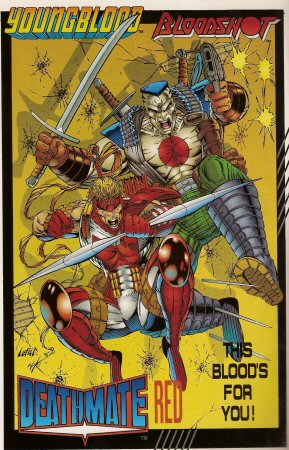
40 Worst Rob Liefeld Drawings
One of the funniest blog entries I've ever seen deals with the terribleness of one of comics' most prolific artists, a man named Rob Liefeld. I cannot read this without rolling around and laughing silently from lack of breath. Sample:

37_medium

"YOUNGBLOOD

DEATHSHOT

DEATHMATE RED

THIS BLOOD'S FOR YOU

S***, who needs to explain why they're jumping together in front of a yellow wall with a spotlight on them, it's DEATH BLOOD MATE SHOT RARRRRHHH

Quick question: Why does Rob Liefeld think guns have two spots at the end of the barrel for bullets to come out?"

Here's the link (warning: curse words aplenty).

Additional links:
Old XKCD webcomics, including this gem.
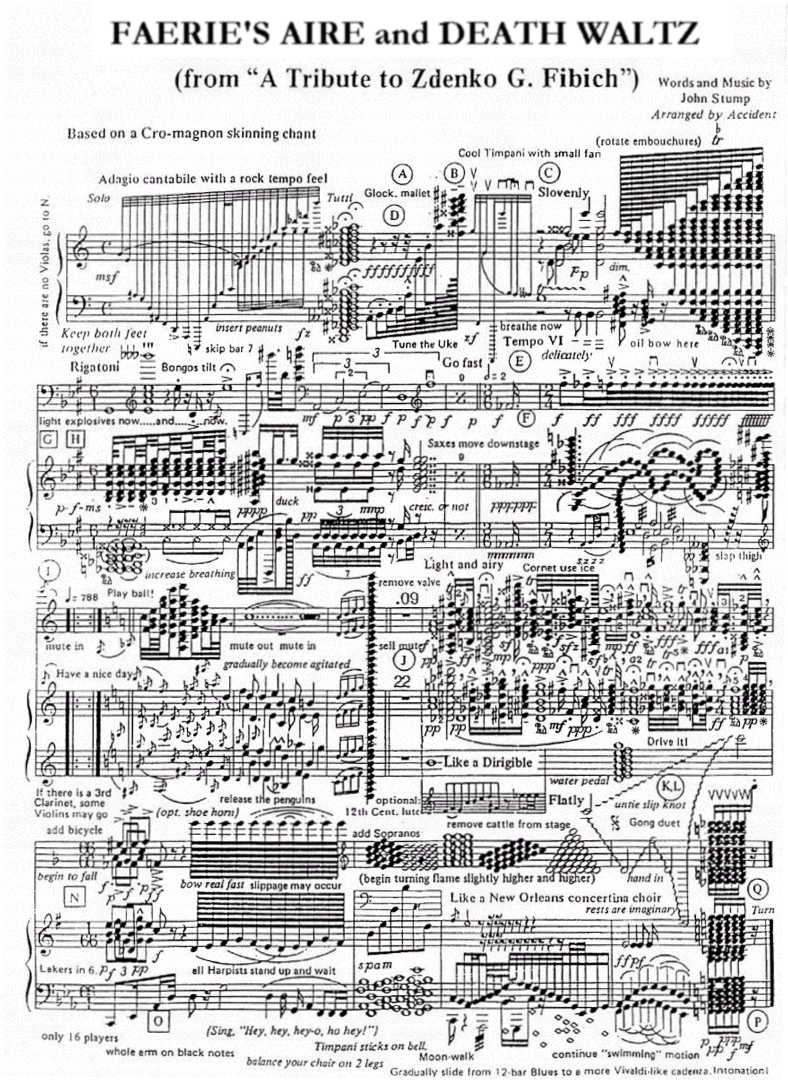
This laborious musical joke, which is not original to the Internet, but which I first encountered there. 

Friday, March 23, 2012

Ex Machina: Superhero Comics and Government

Part of a series of Lists of Cool Things.

The Great Machine/Mitchell Hundred,
Mayor of New York City
And the voice said: 
Neither snow nor rain 
nor gloom of night 
shall stay these couriers 
from the swift completion 
of their appointed rounds.
 

'Cause when love is gone, 
there's always justice.
And when justice is gone, 

there's always force.
—"O Superman," Laurie Anderson

This week, I want to talk about some reading I've been doing, about government, and about comics.*

I just read finished reading through a favorite series of comic books called Ex Machina, about a man named Mitchell Hundred who, as people in comics often do, has an accident, gains special powers, and becomes a superhero. Hundred's powers are the ability to talk to and command machines to do what he tells them to.

Unfortunately for Hundred, his alter ego, the Great Machine, is not very popular...with anyone. Hundred grew up reading comic books with superheroes and supervillains, but as the Great Machine, he finds out that fighting crime as a costumed vigilante in New York in reality is (1) really hard for a variety of reasons—mostly, no one wants him around and he's not very good at it (e.g., he tries to stop people from joyriding on top of the subway and ends up shutting down the whole train system for six hours; he tells two delinquents to go to school and they beat him up) and (2) illegal—the police are after him for causing disturbance and being a public nuisance. He realizes that what he is doing is at best morally questionable, and he decides to try to help others in a different way. He unmasks himself and uses his notoriety as the Great Machine to run for Mayor of New York. 

But since no one wanted him around in the first place, he doesn't get very far. Not far, that is, until September 11th, when the Great Machine uses his powers to order the second plane to land instead of hitting the World Trade Center. As a result of this, Mitchell Hundred is elected mayor. This comic book series, then, is all about his term in office as Mayor of New York: a superhero mayor trying to save the city with politics.

***

In rereading the series and in thinking about it, I noticed an important idea at work throughout—it's present already in the introduction above. It's this idea of the danger of relying on a greater force outside of ourselves to solve all of our problems, in particular, the danger of relying on the government to save us. It is my opinion that a government can and should provide help to its citizens and support them as they pursue life, liberty, and happiness. I know that I have benefited enormously from the workings of the great machine of society (Thomas Jefferson's term), and in particular, from the support of the government (public schools, libraries, roads--even food stamps for a while!), yet I have very little idea of how the system that supports me so really works, or how to involve myself in making sure it works fairly and properly for the benefit of all. Sometimes, like the Great Machine, I just want to get out and go somewhere and do something for somebody—or at least show that I'm trying to be a good person—and sometimes I just end up feeling kind of stupid and maybe slightly racist after the fact. And sometimes, as Mayor Hundred experiences in his time in office, we expect more of our government than is reasonable without more extensive participation and action on our part.

For this week's Illinois primary election, I did a bunch of internet research at the last minute, trying to decide who to vote for in my local elections (i.e., figuring out which Chicago and Illinois State politicians are the least corrupt and morally bankrupt, typically a losing proposition). It was frustrating to realize that, even after serving two years in AmeriCorps, dedicating myself to the improvement of my country through national service and the education of others, I knew so little about how to effect meaningful political or social change through voting. I also know little about public protest, though it's all around me at my work downtown (Occupy Chicago, whether you agree with them or not, are at least surely laudable for keeping the spirit of protest and free speech alive in an increasingly tough city for that sort of thing). Unfortunately, I ended up making a stupid decision that made all my research moot (...ask me about it sometime; no, it wasn't forgetting to vote). It made me consider how far our society would have to go for everyone to know enough to vote responsibly and participate effectively in the system that rules them.

***

Let me come back to my original topic, the comic book Ex Machina. It may surprise you that a heavy theme like "the dangers of the public relying on government to save society" could come out of a comic book. I would have been surprised just a few years ago, when a good friend in college started sharing his comics collection with me. It turned out that comics are more than just superhero stories: in the last several decades, comics have exploded into many genres and worlds of ideas.

The fact is, comics are a medium, a way of telling stories. They can be beautiful or ugly or wondrous or disturbing; the best ones use the blend of visual art and written word to tell a story in a way that no other method of storytelling can. To me, saying that you won't read comics is like saying that you really just don't like, say, books or movies or music: you could say that, and it might be true, but it seems strange to simply discard an entire category of story so candidly. Comics are a method, and they're a unique method that ought not to be dismissed as childish or silly simply because they are often associated in the public mind with children and silliness. I hope you find one sometime soon that will convince you of their power and beauty. Some suggestions are listed below by genre.

History:
T-Minus, a history of the Space Race.
Louis Riel, a biography of a historical figure involved in an important conflict in Canadian history.†
Maus, the story of a man's imprisonment and escape from a concentration camp and his relationship with his son.†
Safe Area Gorazde and Palestine, two comics about a man's experiences during conflicts in the Balkans and in Palestine.†

Realistic Fiction:
Paul Goes Fishing and Paul Moves Out, part of a series of slice-of-life comics about a Quebecois family.
The Big Kahn, the story of a Jewish family that finds out their Rabbi father was not Jewish after his death.†
Incognegro, story of a black reporter passing as white in the South in the early 20th century.†

Fantasy/Adventure:
Hellboy, the story of a demon monster-hunter.†
American Born Chinese, a series of interlinked stories about Chinese heritage/culture and growing up Chinese in the US.
Surrogates, a sci-fi future where everyone has robot bodies that perform all their actions in the real world, operated safely from home.†
Concrete, in which a man gets put into a giant alien stone body and uses it to travel the world, accomplish great feats or endurance, advocate for good causes, and generally do things not typical of superheroes.†


*Note: I'm not a scholar, at least not in the field of comics, so let me point you to two books with a world more to say and better ways to say it than I have: Understanding Comics, the Invisible Art (or, if you're interested in a more recent and more creation-oriented book, Making Comics) is a wonderful book that describes what comics are, why they're good, and what they can do (and it does it all through comics, i.e., it is a comic book in itself) and Reading Comics: How Graphic Novels Work is a book which not only discusses what comics are and what they can do, but which also goes on to investigate and analyze numerous comic artists and their work in detail. Both are great, I assure you.
†These books are probably best suited to adults, as they have adult language and themes.