Showing posts with label Essays from a Christian Perspective. Show all posts

Friday, June 27, 2014

Reparations Are Our Collective Responsibility

MLK, in a short video clip, speaking about reparations
People get ready, there's a train a-comin',
You don't need no baggage, you just get on board.
All you need is faith to hear the diesels hummin',
Don't need no ticket, you just thank the Lord.
—"People Get Ready," Curtis Mayfield

Just over a month ago, Ta-Nahisi Coates, national correspondent at The Atlantic, posted "The Case for Reparations," a 15,000-word piece of journalism that I have been unable to put out of my head ever since. Part historical narrative, part on-the-ground reporting, and part persuasive rhetoric, "The Case for Reparations" persuasively and compellingly lays out an argument in favor of reparations for African Americans who have been negatively affected by structural, legal, government-sanctioned racism in America.

The subtitle of the piece is "Two hundred fifty years of slavery. Ninety years of Jim Crow. Sixty years of separate but equal. Thirty-five years of racist housing policy. Until we reckon with our compounding moral debts, America will never be whole." In enumerating the harms done to African Americans since slavery, the subtitle points toward the thing that separates this Case from your ordinary street-level conversation about reparations: the basic argument against them has always been "the slaves are all dead now." Coates points out that you don't have to go back to dead slaves to find African Americans who have been harmed by legalized racism; there are people alive and well today who could and should benefit from direct reparations.

~   ~   ~

Reparations have never before this year been a subject of interest to me; while my interest in left-wing politics has been growing for some time, reparations haven't really ever been on my radar, and if you'd asked me about them any time before 2014, I would have told you I thought they sounded like a bad idea at best.

"The Slave Trade" by Auguste Francois Biard. Source

The thing that jolted me into turning in a different direction was an article about how slavery made the modern world. The article describes the way slavery (that is, the West's race-based chattel slavery of the last several centuries) undergirds so much of what we take for granted in modern life. This is especially true in America, where slave labor was the economic engine that drove the most of country's early growth and prosperity.1 American slaves, of course, were never officially compensated for their unpaid labor, much less the loss of their freedom, and the result was that emancipated African Americans as a group started their free lives with grave economic disadvantages compared to most of their fellow citizens.

Since reading that article, my opinion on the need for reparations has gradually shifted from a hard "no" to a soft "yes." I found myself musing about it at odd moments: "So what if the slaves are all dead now? Let's do a thought experiment: my father works for a company that denies him a paycheck, and then he dies. Don't I have the right to ask the company for the money he was owed, since I would have inherited it if they hadn't denied it to him? How much more, then, do the descendants of slaves have a right to ask of the society that never paid their ancestors for their labor that they be given something in compensation? After all, they, and their parents, and their grandparents, and so on, would have inherited and benefited from that original wealth if it had not been unjustly denied to the slaves."

~   ~   ~

Abraham Lincoln addresses the nation. Source
In "Puritans and Prigs," a wide-ranging essay about America, society, religion, and morality, Marilynne Robinson laments the current shift away from a sense of collective responsibility in America. She writes of our country before its most recent decades:
When things went wrong in Calvinist America, the minister or mayor or governor or president, including of course Lincoln, would declare a Day of Fasting and Humiliation, during which businesses and offices closed and the population went to their various churches to figure out what they were doing wrong and how to repent of it. The assumption of present responsibility for the present state of things was a ritual feature of life in this culture for two and a half centuries, and is entirely forgotten by us now.
The Death of Adam, pg. 155
Americans have a pretty good grasp of individual responsibility; it's considered quite important here, especially on the political right, where it's an absolutely essential, core value. I take care of myself, and I am responsible for my own failures. Collective or societal responsibility, though, is valued almost nowhere in the States, except perhaps on the fringes of the political left. The notion that I can or should be held responsible in any way for something I didn't personally do—like, say, enslaving people—runs directly against the grain of modern American individualism. What Robinson goes to some lengths to show in her essay is that this blindness to collective responsibility is not a fundamentally American phenomenon but a modern, recent American phenomenon, and that it is something very much worth pushing back against.

~   ~   ~

In an interview with the Washington Post, Ta-Nehisi Coates points out that collective responsibility isn't actually all that foreign to modern Americans either, if we just stop and think about it:
We pay for things all the time that we didn’t do...I wasn’t around when World War I happened but we’re still paying pensions. That had nothing to do with me, but I understand that I have to pay into that. That’s sort of what government means. If a state dies with every generation, what kind of state is that? When people talk about debt, or the state of Social Security, they talk about what kind of world are we leaving to our children. They understand that the country continues, that the country was here before us and that it will be here after we die.
All Americans benefit from slavery, because we live in a country that was built by slaves, not just in economic and other figurative ways, but also in a very concrete sense.

~   ~   ~

Two things about "The Case for Reparations" set it apart and make it really shine. First, as I mentioned at the start, even if you reject the notion of paying people for evils done to their deceased ancestors, Coates makes a strong case for reparations to living people, too. I won't spell it out here, since this post is getting long, but suffice it to say that living African Americans have been harmed by official, legal policies of the US government, and deserve restitution for that harm.

Second, and even better, is what Coates elsewhere calls the "radical practicality" of reparations. The idea of reparations has this veneer of pie-in-the-sky, crazy bleeding-heart liberal scheme to it, but Coates shows that it is actually completely doable, for a number of reasons:
  • It's been done before: 
    • Americans have paid reparations for other collective wrongs, internment camps for Japanese Americans, for example. 
    • We've actually also paid reparations for slavery, just the wrong way round: a post-Civil War act of Congress paid reparation to former slave owners for the loss of their "property" due to emancipation! 
  • It's been done elsewhere in the face of staunch opposition: Germany paid reparations to Jews after WWII, even though most Germans and Jews opposed reparations, and they ended up both boosting the German economy and helping build the foundations of the new state of Israel.
  • There's even a bill in the US House of Representatives, that ordinary Americans can support by calling their representative. It's brought before Congress every year, and it advocates a simple study of the idea of reparations, surely a very practical measure.2 
~   ~   ~

My dad always said the conclusion to any piece of writing has to answer the question, "So what?" In this case, the more pointed and relevant question is: "Why are reparations important if I'm not going to be a beneficiary?" I think the answer is complicated, but it's related to that Marilynne Robinson quote from earlier. American society has a profound need to grapple with the issue of collective responsibility, responsibility both for the way things are now and for recognizing and correcting the wrongs in our past. Many of our country's deepest ills stem from a refusal to acknowledge or atone for collective wrongs, past and present. I think the conversation about how race factors into those wrongs is crucial, and it's a conversation that's not been adequately attempted or even imagined by most Americans. I think the idea of reparations in general, and discussion of "The Case for Reparations" in particular, can be a step in the right direction for our nation.3

~   ~   ~

Two final items: first, here is a link to all the articles on reparations that I've found and posted on my Tumblr this year; I'm sure there will be more over time. Second, if you're looking for the quickest and funnest entry point into Coates' work and ideas, check out his six-minute interview with Stephen Colbert below.


1. For example:
In the United States, scholars have demonstrated that profit wasn’t made just from Southerners selling the cotton that slaves picked or the cane they cut. Slavery was central to the establishment of the industries that today dominate the US economy: finance, insurance, and real estate. And historian Caitlan Rosenthal has shown how Caribbean slave plantations helped pioneer 'accounting and management tools, including depreciation and standardized efficiency metrics, to manage their land and their slaves'—techniques that were then used in northern factories.↩
2. John Conyers, the bill's author, says of it:
H.R. 40 has strong grass roots support within the African American community, including major civil rights organizations, religious organizations, academic and civic groups from across the country. This support is very similar to the strong grassroots support that proceeded another legislative initiative: the Martin Luther King, Jr. Holiday bill. It took a full 15 years from the time I first introduced it on April 5, 1968 to its passage in the fall of 1983. Through most of those 15 years, the idea of a federal holiday honoring an African American civil rights leader was considered a radical idea. Like the King Holiday bill, we have seen the support for this bill increase each year. Today we have over 40 co-sponsors, more than at any time in the past. What is also encouraging is the dramatic increase in the number of supporters for the bill among Members of Congress who are not members of the Congressional Black Caucus.↩
3. My biggest concern about the implementation of reparations is backlash from white people. Not because I think white people are inherently racist, but because we happen to be living in a time of incredible economic inequality. I suspect that if white people see back people getting an economic benefit without a simultaneous effort to enact some kind of all-encompassing, non-racial economic equalizer for American society in general, things are going to get ugly. Which is less a concern about reparations than about economic inequality in general, I suppose.↩

Friday, June 20, 2014

Godwin's Law and the Nazi Rhetorical Paradox

Mel Brooks as Hitler, sans Hitler costume. Source.

It all began down in Munich town,
And pretty soon the word started gettin' around.
So I said to Martin Bormann
I said, "Hey Marty, why don't we throw a little Nazi party?"
We had an election, well kinda sorta,
And before you knew it, hello new order!
To all those mothers in the fatherland I said,
"Achtung, baby, I got me a plan!"
"Whatcha got Adolf? Whatcha gonna do?"
I said "How about this one:
World War Two!"
—"To Be Or Not To Be," Mel Brooks (there is no actual nudity in it, but I can't imagine the video linked here is safe for work at all)

"Say what you want to about the tenets of [insert ideology here], at least it's an ethos."
—a friend of mine, whenever he wants to subtly compare something to Nazism*

A well-known rule of the internet, Godwin's Law, states that "As an online discussion grows longer, the probability of a comparison involving Nazis or Hitler approaches 1." A corollary to this law, one which I wish were observed more often, is that whoever uses the comparison automatically loses the argument and the discussion must immediately cease:

"Constantly stopping these briefings halfway through is becoming a pain." Source 
There's a paradoxical quality about appeals to Nazism to bolster one's argument. They don't really work because, on the one hand, Nazis were Pure Evil, and on the other, they really weren't that different from you and me at all, dear reader.**

Let me break that down.

1. The Nazis were Pure Evil

The reason comparisons to Nazism don't work as rhetoric is the same reason the words "never" and "always" don't work as rhetoric.

A few years ago, I learned to avoid absolutes in trying to convince someone of something. If say, you're trying to convince someone to change their habit of eating lots of cookies,† telling them "You always eat five cookies when you get home from work" or "You can never seem to keep from eating cookies when you have the chance" is a bad strategy, because all the person has to do is think of one counter-example ("I only ate four cookies when I got home from work on Thursday!") and you're wrong, your argument is suddenly weak, and the person is unlikely to be convinced.

Similarly, comparisons to Nazism are easy to push aside, because everyone knows that the Nazis were just the worst, man, like literally. Since our culture treats Nazism as the absolute height of all evils, and Hitler as the pinnacle and archetype of that evil, comparisons to Nazi ideology or the Fuhrer don't hold much water, because it's easy to find counter-examples and undermine the argument ("Obama isn't just like Hitler; Hitler was a vegetarian!")

2. The Nazis were just some dudes

Some recent reading I've been doing has brought the opposite side of this coin to my attention quite sharply. We treat Nazism and Hitler as radical, ultimate evil, but in reality there's a discomfiting degree of continuity between ourselves and Hitler, between American national ideology and Nazism.

Dale Aukerman's book Darkening Valley: A Biblical Perspective on Nuclear War was recommended recently to me by a friend of my wife (and, I think, a new friend to me also). It initially struck me as an odd topic to read about, but the book's recommender assured me it was worth my time, and he was not wrong.

The project of Darkening Valley is to discuss nuclear war through Bible stories. Each chapter takes a particular story from the Bible and uses it to explain and engage with an element of nuclear war; the opening chapter, for example, uses the story of Cain killing his brother Abel to remind the reader that a tendency toward violence is a deep element of human nature, and then goes on to point out how dangerous that fact is in conjunction with the fact that humans now have the weapons required to destroy themselves nearly instantaneously.

Aukerman touches on Hitler and Nazism often throughout the book, circling round again and again to examine the ways in which the specter of the Nazis has been used to justify war and the threat of war. Most strikingly, in a chapter titled "Hitler and the Woman Caught in Adultery," Aukerman discusses the "dark continuity" between himself and Hitler, between Nazism and the rest of the human race, and uses the story of the woman caught in adultery and brought to Jesus to illustrate his point. I'll quote Aukerman at length here, since he's substantially more eloquent than I am:

I want to challenge the assumption that there is a sharp discontinuity between who we are and who Adolf Hitler was, and the parallel assumption of discontinuity between our particular society and Nazi Germany. It is crucial for us to recognize not only the continuity between the darkness deep in each of us and the darkness in Hitler, but also a continuity between positive impulses and longings within us and those, even if to a large extent atrophied, within Hitler. 
The evidence that substantiates this dark continuity is manifold: many of the experimental findings of contemporary psychological studies of aggression and violence; any introspection which owns up to lethal sentiments, murderous fantasies and racist presumptions within us; the final stages of World War II in Europe during which the Allied nations outdid the Axis powers in unleashing violence; the prevailing popular attitudes in Allied countries toward the Nazis then and now. The attitude that Hitler and those around him were so wicked that they simply had to be done away with, was identical to the darkness that was being combated: a readiness to do away with those seen as enemies, a driving need to annihilate those reckoned unworthy to live.
It is most of all in the scriptural witness that we are shown the nature of this dark continuity...[T]he most revealing passage is...the story of the woman caught in the act of adultery. The Pharisees and the doctors of the law could come as they did because they recognized no continuity between who they had been and were and the publicly exposed adulteress. Jesus, moving to save the woman from execution, sought also to save her accusers from perdition and to bring them to a recognition of this continuity. It may be that most or even all of the accusers had not committed adultery as a physical act. But he who in the Sermon on the Mount probed into the depths from which such acts emerge was doing the same here. He wanted to express to his antagonists that a conspicuous example of wrongdoing, rather than reinforcing an exultant self-righteousness, was to bring awareness of the sin common to all human beings and of the shared need for forgiveness and conversion...  
All the desolation of nature, the razing of cities, the slaughter of millions of human beings carried out by Nazi Germany was only a limited foreshadowing of the desolating, razing, annihilating which the peoples of West and East are prepared to carry out. During years of residence in West Germany, I often wondered how decent, good-hearted Germans could have gone along with Nazism. Some of the answer comes through asking the same question of Americans (including myself at a certain level) and nuclear weapons. There is the drivenness of both those who lead and those who are led; fear of determined adversaries; emptiness within individual and society; the lure of power; the drive to be the center of the universe; the infernal darkness within, which the Dark Powers from without align with themselves. The Yes to nuclear weapons by good-hearted Americans who are distraught by the death of a pet and full of altruism toward neighbors recapitulates that earlier yielding to the Dark Powers by Adolf Hitler and those who moved in concert with him.
Dale Aukerman, Darkening Valley, pgs. 19 and 22, emphasis added 
My point, and Aukerman's point, is not that the Nazis and Hitler were good, or even that they weren't evil. It is simply that when we use the Nazis for rhetorical point scoring, when we hold them up as the highest, purest example of Evil, we miss the opportunity to actually reflect on what Nazism was and to use that reflection for tangible, human good. We miss the chance to see their darkness in ourselves and our neighbors, and to work actively to resist that darkness. We blind ourselves, and we risk a tragic stumble.

*This is a play on a quote from the Big Lebowski.
**I mean, especially if you're a Nazi, dear reader, because I certainly can't tell who you are from this side of the screen. But even if you're not a Nazi, is what I'm saying. Get it? If not, uh, read on, I promise I explain elsewhere outside this footnote.
†It's a hypothetical example. Stop looking at me like that.

Friday, March 15, 2013

Christian Anarchism: A Response

This is part of a series of Essays from a Christian Perspective.

I want Mashiach now, so it's time we start revealing.
For today's post, I am taking a suggestion from a friend and writing a response to this blog post about the relationship between Christianity, Anarchism, and "Atheism" (you'll see what I mean by the scare quotes when you read it—the way the writer is using it has nothing to do with what we usually think of as atheism, and that's okay). Because this post is just that, a response to something, I recommend you read the original post and come back to this one to get the full experience.

The author of the post wants, in part, to show that Christianity is an "anarchist" religion, meaning that it is a religion that, at its roots, is about rejecting the idea of people governing each other, and that favors loyalty to and sole leadership by God. I think there is a case to be made for this, but I think the post makes some key mistakes along the way, mistakes that miss something I think is interesting, and maybe even important.

The big flaw in the post is the assertion that the Hebrew Bible has a beef with earthly rulers ("an anarchist strain runs through the Old...Testament"). The author holds up an extended quote from the book of Samuel as his main example*, but there's a great deal of evidence that, on the contrary, the Hebrew Bible is not at all an anarchist book.

There is a great deal of non-anarchism (archism?) in the form of pro-monarchy sentiment in the Hebrew Bible. God legitimates the idea of a king in Israel as far back as their wanderings in the desert (Deuteronomy 17:14-20). In the book of Judges, you see the phrase "there was no king in Israel" two times, right before something terrible happens (the creation of a major shrine to an idol, and a civil war), which basically comes off as "there was no king to prevent these terrible things from happening so wouldn't it be great if there was a king?" The Psalms are full of positive references to kings, including hope for the king's victory (Psalm 20:9), statements of the king's blessedness (Psalm 21), direct praises to the king himself (Psalm 45), and even visions of God speaking to the king and calling him God's son (Psalm 2:6-9)!

If there is any "anarchist" strain in the Hebrew Bible, it is not in the idea that people ruling themselves is a bad thing in itself, but rather that it is a problem when the ruler interferes with the people's relationship with God. It is almost universally this activity that gets kings condemned in the Bible; it happens throughout the book of Kings, when various kings lead Israel astray and keep Israel from worshiping God, and it is Nebuchadnezzar's crime in the book of Daniel. If you're a king who lets Israel worship God, even if you're a foreign king like King Artaxerxes in Ezra-Nehemiah, you get a pass; and if you're a king who won't let Israel worship God, like Pharaoh, you're condemned. Given that there are plenty of both kinds of rulers, who do and don't make this mistake, it's hard to see the overarching theme as "anarchist" in nature. 

***

So what? Does it really matter if there's an "anarchist strain" or not in the Hebrew Bible? Maybe not. But I want to point out that it is precisely because of the pro-kingship nature of the Hebrew Bible that both the New Testament and Christianity exist in the form we have them.

The idea of a "messiah" is rooted in the central role that the king played in Israelite religion. "Messiah" is just the word for "anointed" in Hebrew†, and it was used, among other things, to refer to the king of Israel, who was anointed with oil as a sign of his kingship. Later, in Jesus' time, it had come to be used to describe a hoped-for person who would save Israel from its troubles, a king who was descended from the legitimate king of Israel, David. Christians believe that Jesus is that hoped-for person, but that rather than saving Israel from the Romans a few thousand years ago by becoming a temporal king, he saved everyone by dying for us and thereby removing a barrier separating us from God.


The important thing here is that the New Testament connects Jesus with the king/messiah imagery very strongly. He is described as being descended from David, even as being born in David's city, Bethlehem. Without a pro-king slant in the Hebrew Bible, there's nothing tying Jesus to God's promises, no sense that Jesus is the fulfillment of a longstanding plan on God's part. Instead, Christians can see Jesus as a once-and-for-all follow-through on God's promise to establish the house of David as kings forever, and as a ruler who, unlike many of Israel's former kings, mediates our relationship with God properly. Plus, as we see in Psalm 2, God was thought of as having a close, even father-son relationship with the king:
[God said: ]‘I have set my king on Zion, my holy hill.’
I will tell of the decree of the Lord
He said to me, ‘You are my son;
today I have begotten you.'
Psalm 2:6-8, NRSV
This imagery becomes literal in the case of Jesus, who Christians believe is God's literal son; this little scene from the Psalms is obliquely referenced in the New Testament when Jesus starts his ministry an d God declares Jesus' sonship (here, here, and here). In other words, without the Hebrew Bible's message that kings can be and are part of God's plan for God's people, we don't have a Christianity or a New Testament that sees Jesus as a legitimate part of God's plan from the beginning. And I think that's a big deal.

All that said, the fact the Christians now owe allegiance to a king in heaven before any earthy rulers does, in my opinion, mean that we can consider ourselves a certain kind of anarchists, and I definitely think that the early church acted in a way that reflected that, which the author of the original post describes quite well. (There are some fun details embedded in this book review about how early Christians were perceived by Roman society and how weird they seemed, and would probably seem today.) I can't really speak to the history of how we've reconciled this anarchic tendency in our religion to living in and even creating societies in which we rule ourselves, but that doesn't mean we haven't had to. But I do know that every once in a while, the question of who we really owe allegiance to will come up, and Christians like Bonhoeffer will stand up and say they are Christians first, and (in his case) Germans second; so I think it's undeniable that a certain anarchism is part of who we are as a religion.


* I considered discussing this in the body of my post, but I got a little long-winded and maybe a bit away from the main point in my analysis of the text. Check out the passage and my thoughts below if you've got some extra time; I really am not at all sure that it's a good argument for an "anarchist strain" in the Hebrew Bible at all.
But the thing displeased Samuel when they said, ‘Give us a king to govern us.’ Samuel prayed to the Lord, and the Lord said to Samuel, ‘Listen to the voice of the people in all that they say to you; for they have not rejected you, but they have rejected me from being king over them. Just as they have done to me, from the day I brought them up out of Egypt to this day, forsaking me and serving other gods, so also they are doing to you. Now then, listen to their voice; only—you shall solemnly warn them, and show them the ways of the king who shall reign over them.’

So Samuel reported all the words of the Lord to the people who were asking him for a king. He said, ‘These will be the ways of the king who will reign over you: he will take your sons and appoint them to his chariots and to be his horsemen, and to run before his chariots; and he will appoint for himself commanders of thousands and commanders of fifties, and some to plough his ground and to reap his harvest, and to make his implements of war and the equipment of his chariots. He will take your daughters to be perfumers and cooks and bakers. He will take the best of your fields and vineyards and olive orchards and give them to his courtiers. He will take one-tenth of your grain and of your vineyards and give it to his officers and his courtiers. He will take your male and female slaves, and the best of your cattle and donkeys, and put them to his work. He will take one-tenth of your flocks, and you shall be his slaves. And in that day you will cry out because of your king, whom you have chosen for yourselves; but the Lord will not answer you in that day.’

But the people refused to listen to the voice of Samuel; they said, ‘No! but we are determined to have a king over us, so that we also may be like other nations, and that our king may govern us and go out before us and fight our battles.’ When Samuel had heard all the words of the people, he repeated them in the ears of the Lord. The Lord said to Samuel, ‘Listen to their voice and set a king over them.’ Samuel then said to the people of Israel, ‘Each of you return home.’ 1 Samuel 8:6-22, NRSV
To me, this reads like Samuel is getting upset ("the thing displeased Samuel when they said...") about things not going his way: up to this point in the Bible, judges like Samuel were the only "rulers" Israel had, so he feels personally offended and rejected by the people when they ask for a king. If you read it this way, God's response is mostly just a commiseration with or a consolation for Samuel, rather than a rejection of the idea of kings in general. Indeed, while God tells Samuel to warn the people of what kings are like, the text doesn't make it 100% clear that the big list of things he comes up with are God's idea; it sounds to me like Samuel, more than God, is being super negative about kingship. The last bit about being the king's slaves and the Lord not responding to their cry for help sounds particularly harsh, and I suspect that God had nothing to do with it. Finally, note that it even seems like Samuel gets cranky and refuses to do what God tells him to; he doesn't give the people a king, he just sends them away ("'Listen to their voice and set a king over them.' Samuel then said...'return home'") and only follows through later.

I think the biggest argument against this representing an "anarchist strain" in the Hebrew Bible, though, is that God promises to make someone's (David's) family kings of Israel forever later in the same book (2 Samuel 7:12-16). That is not really the kind of thing one expects from an anarchist text.

† Okay, sort of; it's an English-friendly version; the Hebrew is more like "mashiach." 


Image sources:
Photo 1: http://en.wikipedia.org/wiki/File:Circle-A_red.svg 
Photo 2: http://www.flickr.com/photos/qilin/4133879968/

Friday, February 22, 2013

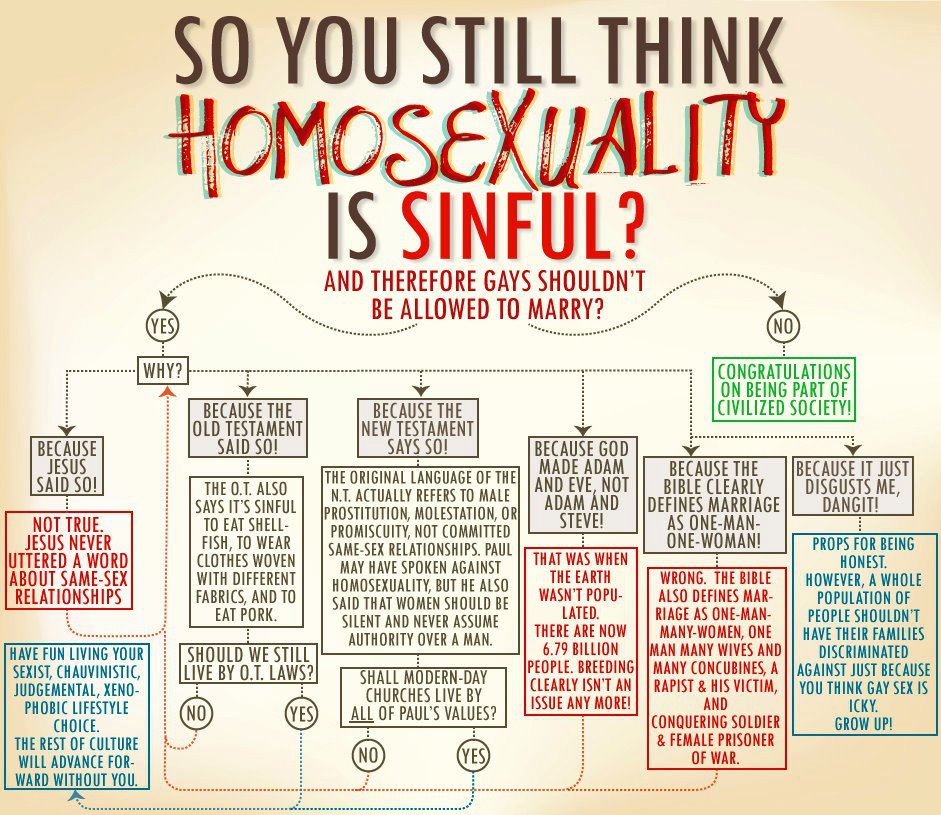
The Christian Cases for Gay Marriage

This is part of a series of Essays from a Christian Perspective.

Wedding bells are ringin' in the chapel,
I hear the children laughing out with glee.
At home alone I hang my head in sorrow,
Wedding bells will never ring for me.

—"Wedding Bells," Lissie

(Before I get to my main purpose this week, I want to point out that it is now the Christian season of Lent, about which I have written a few things. I'm not going to reflect on the season again this year, but I do think that this guy has a particularly interesting perspective on the matter. [I'm a big fan of the sardonic someecards message at the top of the post.])

***

The other day, former Utah governor John Huntsman came out for gay marriage, in an op-ed called "Marriage Equality Is a Conservative Cause." Huntsman is a conservative I find easy to respect and admire, even as I disagree with him on many issues, so it was nice to find myself on the same side as him in an important ideological divide. But in his piece, Huntsman eschewed a case from the perspective of his faith, Mormonism, which is not by any means completely unthinkable. While I've written without much detail on the subject before, reading Huntsman's op-ed made me feel it was time to lay out why I think Christians should embrace gay marriage.


As in any protracted and difficult argument, there are actually a number of different cases for gay marriage and gay relationships within Christianity. I'm going to briefly outline the ones I think are most central. 


1. The Bible does not condemn homosexuality
An important starting point is addressing whether or not the Christian Bible condemns consensual homosexual relationships. There are a number of scholars and exegetes who argue that, in fact, it does not do so. There are a limited number of places throughout the Bible that appear to condemn homosexual practice, but there are strong arguments to be made in each case that something else is being condemned—a failure to practice hospitality, sexual slavery, cultic prostitution, etc. Here is a pretty readable argument taking on the passages in question, and here is a ludicrously detailed one for those who want to really dive into the subject.

(There is another approach to the subject, which is a bit more appealing to me, but more troubling for people with a strong belief in Biblical inerrancy, as it requires you to accept that there are some things in the Bible that are wrong. [Because I recognize that the Bible has historical and scientific inaccuracies, I abandoned this idea some time ago, but there are a number of Christians who have not.] The argument for gay marriage here goes like this: there are parts of the Bible that approve of practices that modern Christians and most people in general find abhorrent, e.g., slavery, but these attitudes are a reflection of ancient cultural norms, not of God's will for human life. Instead of pointing to the few passages that condemn homosexual practice, we should recognize that they are the result of cultural prejudice, and seek to understand homosexuality as a legitimate part of God's creation. This argument is expressed much more eloquently here.)

2. Relating science, Christianity, and homosexuality
Another case can be made by asserting that Christianity (or Religion in general) is not, as is often assumed, contradictory to or mutually exclusive with Science, but that the two are complementary, and should inform each other. Thus, one can look for scientific evidence to inform Christian thought on the matter: whether homosexuality is a naturally occurring phenomenon, whether homosexual relationships can be psychologically healthy and stable, and whether being raised in a family headed by people in a homosexual relationship is harmful to children. The research I've encountered on the subject has been favorable to the conclusion that homosexuality and homosexual relationships are a positive part of God's created order. Here is a link that includes scientific evidence among a range of Christian arguments in favor of gay relationships.

3. Jesus
The last case I want to mention is the simplest to articulate, though defending it is a little more complex. (I won't go into detail here). It goes like this: an incredibly key message of Jesus' ministry was to welcome and include people who had been cast out by his society. By rejecting and condemning homosexuals, making them into outcasts in the Christian community, Christians also reject the message of Christ. Here is a pretty readable argument from this perspective.


There are tons of other cases to be made in favor of gay marriage, but I think most of the specifically Christian ones fall into these three categories. I think together these Christian cases for gay marriage are pretty doggone convincing.

That said, unlike some folks on both sides of this line, I can respect people who hold the opposing view. The only caveat I make is that I can't respect well, hate, and if it's not clear that someone's opposition to gay marriage comes from a place of love for the people involved, then I tend to lose that respect pretty quickly.

Photo 1 source: http://www.flickr.com/photos/mlostracco/8123465348/
Photo 2 source: http://www.flickr.com/photos/fibonacciblue/5728223962/

Friday, December 21, 2012

Why I Am Not A Fundamentalist Christian

  This is part of a series of Essays from a Christian Perspective.

I've got that old time religion in my heart,
Way down inside.
I've got a new kind of feeling in my heart:
Rejoice, abide.
Nobody knows what it means to me,
Nobody knows but my Lord and me.

I received the following response from an item I posted on Facebook (about leaving fundamentalist Christianity without leaving behind everything good about it):
Let me begin by stating that I don't have a full knowledge of church history, and thus do not know when fundamentalism began. However, post-modern teachings, such as those by Rachel Held Evans, are far more recent. The problem that I have with this type of teaching is that it reads a post-modern world view into the Bible instead of allowing the Bible to speak for itself. Also, if by scientific advancement you are talking about creation, this is something I too struggle with. [...] See, I believe precisely the opposite of what you believe, and I would say that the post-modern views strike me as false. I would say that if the Bible doesn't mean what it says, then what does it mean? Can it mean whatever I want it to mean (because I can make it mean some pretty crazy things)? Who is the authority? I would say in a post-modern view, it would be society, and I think that is inherently wrong. Quick question as well: if fundamentalism doesn’t adhere "to age-old tradition and practice" what view does? Or should we even?
I pointed out in an earlier post that Christian fundamentalism, like all religious fundamentalism, is a new phenomenon. I referred my friend to this post, to which the above is partially a response.

My reasons for leaving behind Christian fundamentalism, and particularly Biblical literalism, are complex, and doing so was an important stage in my life. I wanted to share here my response to my friend: 
First, let me say thanks for engaging with me on this topic. It's important for me to figure out what I really think, and that's hard to do on my own without someone to disagree with. For this, I hope we can continue to speak in a friendly manner: these things are important, sure, but they are also mysterious, and perhaps ultimately the truth of the matter cannot be known in this life, so we should be forgiving and understanding with each other. (Not just you and me, but people on both sides of this issue in general.)
Okay, speechifying done. I'm going to try address the stuff in your post in the order it appears in to keep it all straight.
  1. "However, post-modern teachings, such as those by Rachel Held Evans, are far more recent." Post-modernism is recent; I don't have a problem with recent ways of interpreting the Bible. My problem with fundamentalism is that it claims to be the original, oldest, purest way of "doing" Christianity when it is actually quite new. Refusing to accept any non-literal interpretations of the Bible, which is the basic premise of Christian fundamentalism, is new. Christians have been trying to make sense of scripture in other ways for much longer than they have been relying on literal interpretation alone; see, for example, the Fourfold Sense of Scripture (about which you can find more here) that was already in operation over a thousand years ago. (This fourfold sense is basically what I mean when I talk about "age-old tradition and practice." For example, some great Christian thinkers from ages past used metaphorical and allegorical interpretation to understand Genesis. And yes, I think we should be trying to adhere to, or least engage with, such tradition and practice.)
  2. "The problem that I have with this type of teaching is that it reads a post-modern world view into the Bible, instead of allowing the Bible to speak for itself." My experience is that modern and post-modern Christian thought seeks to understand the context of scripture, to know what was going on in the world around the person writing the words. It then tries to use that to help understand scripture better; perhaps even to decide which portions of scripture are still applicable to our daily lives in their literal meaning, and which portions are applicable no longer. I see this process as the opposite of imposing a modern worldview on an ancient text: instead, we are trying to understand an ancient text and adapt it to the world we actually live in today (and that, I think, is really "letting the Bible speak for itself"). 
  3. "Also, if by scientific advancement you are talking about creation, this is something I too struggle with." Creationism was actually my starting point for rejecting fundamentalism. From a young age, I realized that either I had to utterly reject many of the findings of science, or start interpreting at least some of the Bible as not literally true. I was worried about this for a while, but I talked to my dad about it, and he pointed out that scripture can make more important points than "X happened," and in fact is usually doing so, so why should I be concerned? I don't care if God created everything in literally six days; what I care about is the other big ideas the creation story is very clearly telling me, though not in a literal list of items: God is in charge of everything and is in some strong sense its author and master; humans are special because of our relationship to God; we are charged with taking care of what God has made. I don't need to think that the creation story is historically accurate to think those things are true. And the story is a beautiful, memorable way to learn those truths. They would not benefit from just being written out in a list at the beginning of the Bible.
  4. "I would say that if the Bible doesn't mean what it says, then what does it mean? Can it mean whatever I want it to mean (because I can make it mean some pretty crazy things)." Here is how I view the Bible: the Bible is God's word. (Note: this is not a particularly post-modern view, if I understand correctly.) God has ultimate authority to determine what humans should and should not do, and God's main medium for telling us this is the Bible. But trying to hear God speak using only the literal meaning of the words is tricky. There are times when God speaks directly to people in the Bible and tells them what and what not to do: sometimes they are things we Christians think we should pay attention to (like the Ten Commandments) and others aren't (like how we should kill witches—this is a clear case where "letting the Bible speak for itself" in a literal sense doesn't work and Christians don't do it). But for pretty much any other story, you have to do at least a little work to make it matter at all to you (who cares if God literally saved Daniel from the lions' den? No one, unless we do a little interpreting and say that we believe God will also save us from harm if we are faithful to God) That meaning is pretty obvious though, which is true of much of the Bible. I don't think, and most people don't, that you can just make up a meaning that you like and put it with a text. Who will buy it? The meaning has to make sense from reading the story, and from knowing its cultural and textual context. That said, there may be parts of the Bible that were intended for ancient people and are just not relevant to modern people (like, say, rules about hwo to treat your slaves). One of the big problems for modern believers is figuring out what those parts are.
  5. "Who is the authority?" When, in my own life, I combined number 3 (some of the Bible can't literally be true if the modern world is to make any sense) and number 4 (literal sense is less important in many, many cases than the meaning behind the story) I stopped seeing the Bible as needing to be literally true. So I turned to a way of thinking that says "let's try to get the meaning and richness out of it anyway." Like you, and pretty much every fundamentalist, I was worried about who was in charge of determining what those meanings were (and, as I mentioned above, whether there are parts of the Bible that just don't apply to our lives anymore). My answer is that the person in charge is, first, God—we can trust God to help and guide us as we try to live in 2012 AD and not 2012 BC—and second, the Church, the body of believers, praying, discerning, and communicating with each other, just as we have these last two millennia.
Arriving at these conclusions took a long time, a lot of personal reflection, and, especially, a great deal of reading. If I could recommend any book to read on the subject of there simply being more, as well as more important, meanings in the Bible than the literal sense, it would certainly be The Meaning in the Miracles, by Jeffrey John. It's a beautiful book.  


Friday, August 31, 2012

The Salvation Army: A Frustrating, Wonderful Church

This is part of a series of Essays from a Christian Perspective.

Joy, joy joy! There is joy in the Salvation Army!
Joy, joy, joy, 
In the Army of the Lord.  
—"Joy in the Salvation Army," William Pearson & William Bradbury 

Note: inspiration for this week's blog post came from two sources: my friend Julia, who asked me about my church, and the BBC show "Rev.," which is about a vicar in the Church of England and his struggles with, among other things, the idiosyncrasies of the modern Christian church—it's an awesome show!

I grew up attending church at the Salvation Army. It was a great place—and a great way—to grow up.

That the Salvation Army is a church surprises a lot of people: most folks in the States associate it with thrift stores, or social work, or perhaps disaster relief. So a pretty stable part of my childhood, and indeed my whole life, has been explaining that in addition to those ministries, the Salvation Army is indeed a denomination of the Christian faith. In the early years this was frustrating, but now it's as natural as breathing.

I was not big on tough questions, analysis, or challenging authority as a child, so I viewed the Salvation Army as a wholly benevolent and wonderful organization until I became an adult. These days, I still have a lot of good to say about it, but I also have a number of profound frustrations; some of them based on my personal preferences and beliefs, and a few that I see as objective problems with the church, regardless of my beliefs.  I thought it would be healthy for me to articulate both frustration and joy here. (Disclaimers: if you are a member of the Salvation Army, please take these criticisms constructively, because I love the Salvation Army and would never mock or insult it; if you are not a member of the Salvation Army, and are not familiar with it, please remember that these are simply my opinions, and not necessarily the whole truth on any of the issues at hand.)

I'll start with the criticisms and then get to the good stuff.
  • Bureaucracy: This one is common to most churches today, especially in the West, where various scandals and lawsuits have made red tape inevitable. (If you've got 30 minutes to spare, I highly recommend season 2 episode 1 of Rev. for an amusing angle on the subject.) But the Salvation Army is the place where I have the most direct exposure to church bureaucracy and where I am frustrated by it the most. In particular, many administrators seem to enjoy exercising their power by creating and enforcing rules for rules' sake. A case-by-case approach or one taking mitigating factors into account is rare. Example: I was teaching a class (on my own and the student's free time—not a scheduled course) to some students at the Salvation Army's seminary, and after a few months got hauled in to an administrator's office and reprimanded. My crime? I hadn't told any higher-ups that I was on campus teaching a class (...to my friends...on our free time). I was accused of "sneaking around" and violating various rules that I didn't know were rules. My students were also reprimanded.
  • Christian Fundamentalism: The Salvation Army as a whole is not a fundamentalist sect. But there is a strong trend toward and identification with fundamentalism among many of its laypeople and leaders. Fundamentalism is, in my understanding, a modern phenomenon. It is a way of reading scripture and practicing Christianity that is not, as it might claim, adhering to age-old tradition and practice, but rather by nature a reaction against modernism and therefore quite recent. Its focus on Biblical literalism, rejection of scientific advancement and reason, and frequently apocalyptic mindset strike me as both deeply troubling and thoroughly backward. Example: when I was waiting with family in the hospital while my mom was having surgery, the Salvation Army ministers waiting with us tried to strike up a conversation about how Obama was probably the Antichrist. (I was livid, but I walked it off.)
  • Social Conservatism: I identify as a left-leaning moderate (or a straightforward liberal; it depends on the day) politically. So I find conservative viewpoints to be frustrating, especially when they are backed by religion, which they often are in the Salvation Army, from pulpits or in Bible study or youth groups. That is not to say that conservative viewpoints are all wrong or incompatible with a right reading of scripture, just that I find them frustrating. That said, I do thoroughly disagree with the Salvation Army's conservative take on homosexuality, which you can read here. Go ahead and read it if you like; it's actually a very gentle, kind statement, to my eyes, not particularly harsh or judgmental. But it is based on a fairly narrow reading of scripture, and it makes little attempt to account for the fact that, if we are God's creations, then some of us are created homosexual. I will not go into all the reasons I disagree with the Salvation Army's position; my thoughts and those of many others on the subjects of homosexuality and traditional marriage are decently summarized (if somewhat playfully) here and here. 
  • Worship Style: I've discussed things like this before, so I won't dwell on it much. The Salvation Army has some very unique worship elements, but overall it's often very similar to many other "low church" settings: guitars, drums, words projected on a screen, PowerPoint sermons, and so forth. It is a style driven by the desire to attract people with the familiar, rather than a desire to connect worshipers with the body of believers past and present. (An episode of "Rev.," [season 1, episode 2] explores this issue; some great commentary on the episode can be found here.)
With all those things I find frustrating, you may ask, why do I bother associating with "the Army" (as we often call it) at all? 


Here, briefly, are some reasons: 
  • Love: The Salvation Army is full of wonderful people who love each other, God, and their neighbors. There's a reason I've grown into a fairly well-adjusted, kind, faithful person: I had a lot of really good examples to look to when I was growing up in the Army.
  • Social Justice: More than any church I've ever visited, been a part of, or read about, the Salvation Army views its primary mission as serving others, especially the poor, broken, and suffering. This, to my mind, is a fundamental element, if not the primary function, of the Church of Christ in the world (though it shames me to write it, as one who often neglects this duty). I'm proud of the Army for holding up this example to other churches and to the world.
  • Global Family: Salvationists (as we call ourselves), no matter where we are on the globe, feel connected to one another as part of the same church, in a way that I've rarely heard described in other churches. I've done a fair amount of travel, and whenever I visit a Salvation Army, be it in another state or another continent, I am instantly welcomed, and often I am already known. This is the universal experience of Salvationists. Perhaps it is because the church is so small—100,000 members in the U.S., 1,000,000 worldwide—but I think we welcome and befriend each other so readily because we know what the Army is about (loving one's neighbor, caring for others) and we trust that other Salvationists know it too.
I assure you there are other reasons to love the Salvation Army; these are the big three for me. I hope I have been able to communicate my care for this church adequately; I am frustrated by it because I love it. I do have high hopes for it in the future. 

Sources: 
Photo 1: http://commons.wikimedia.org/wiki/File:StampUSA1965SalvArmy.jpg 
Photo 2: http://commons.wikimedia.org/wiki/File:FEMA_-_38827_-_The_Salvation_Army_feeding_people_returning_to_Galveston_Island.jpg

Friday, June 15, 2012

The Apocalypse and Dietrich Bonhoeffer

This is part of a series of Essays from a Christian Perspective.


So when the last and dreadful hour
This crumbling pageant shall devour,
The trumpet shall be heard on high,
The dead shall live, the living die,
and Music shall untune the sky!
—"A Song for St. Cecilia's Day," John Dryden*

"The ultimate question for a responsible man to ask is not how he is to extricate himself heroically from the affair, but how the coming generation shall continue to live."
 —Dietrich Bonhoeffer

It's hard to deny that the apocalypse is a current cultural obsession. It's in the movies and tv shows we watch and the novels or comics we read. And it's been on my mind recently. 

Let me back up, briefly and define my term. When I say "apocalypse," I'm talking about an event that sweeps away the old order of things and replaces it with something new. Often, this involves the deaths of many, many people, and typically, the thing that replaces the old order is simple dis-order: a lack of society of any kind. There are plenty of exceptions; there's a whole sub-genre of post-apocalypse dystopias, where some horrible sweeping event like nuclear war or a sudden drop in birth rates leads to a dramatic change in the organization of society for the worse. At all events, the apocalypse is arguably real, real bad. Like, the worst thing ever, or close.

Yet we appear to be thinking about it, in one form or another, a great deal. On the surface, this seems healthy: it's important to be concerned about the possibility of the end of things, to consider that possibility and seek to avert it or at least confront what it might mean. And it's possible that this is what some apocalypse-focused culture is about: I would hold up, say, Soylent Green or The Road as at least partly if not primarily about warning people about the end of things as they are and getting them to face that possibility.

If that's all that we were doing by obsessing over the apocalypse, I would wipe my hands and declare everything to be okay, or at least acceptable. It's not all we're doing, though. It's certainly not why I saw, say Zombieland, or why I liked Y: the Last Man. I think we obsess over the apocalypse because (1) we're worried about the state of things as they are; things are clearly changing all around us, and it's unlikely they are changing for the better, and (2) we want to know that things will be okay anyway. When I see that Jesse Eisenberg survived the zombie apocalypse by being slightly neurotic and having a gun, I'm not thinking about how to keep the world from getting terrible; instead, I'm helping myself feel like everything's going to be okay: if this guy made it through something that awful, then I can too. I don't need to do anything about the state of things as they are.

***

I have a theory about where this impulse comes from. The U.S. is either a Christian society or a post-Christian one, depending where you are and who you ask. Either way, the impulses of Christians, positive and otherwise, are our society's impulses, or the ancestors of them. And one huge impulse in Christian history (related, in fact, to a similar impulse in many religions) has been to hope for a capital-A Apocalypse in bad times.

The classic, and probably earliest, example is the Book of Revelation in the Bible. When this book was written, Christians were the direct target of some very serious persecution. To be a Christian anywhere in the Roman Empire was a capital offense. So Christians in the Roman Empire needed some comfort; one way they received it was from this book, Revelation, that said that someday there would come a time when God would wipe away the old order of things and establish a new one, where everything would be great and you wouldn't have to worry about someone cutting your head off for thinking Jesus=God or drawing a fish in the sand.

And Christians have been returning to that hope, and to Revelation specifically, ever since, especially when things look rough. The question I want to raise is: is that a healthy thing to do? Is it really okay to say, "everything's going to be okay someday" in response to trying times? If so, is it okay to pair that with, "so we don't need to do anything about the way things are now"?

***

I want to answer by offering an alternative example. It's arguable that there have been few times or places worse than Germany under the Nazis. A series of changes over the course of a few short years led to a severe restriction of personal freedoms, imprisonment and death for dissenters and minorities, and compulsory participation for many in a war of aggression, earning the ire of the rest of the world. It was a bad time. 


Enter Dietrich Bonhoeffer, a pastor and theologian born and raised in Germany before the rise of Nazism. I am not an expert on his life or theological writings, so I will try to be brief in my descriptions of his life and actions.†

Basically, as a pastor, Bonhoeffer had several options when the Nazis came to power. He could go along with the German Lutheran Church, which was taken over by the Nazis, expelled non-Aryans from the church and looked to Hitler as its leader. But he could also, I want to point out, have taken a traditional Christian route: preaching that the Apocalypse was near or that death and martyrdom were the best way to confront Nazism.

Instead of doing either, Bonhoeffer addressed the situation as a problem that he and his fellow Christians could address through active, open resistance and, failing that, subterfuge. During the Nazi years, Bonhoeffer helped start a Christian movement called the Confessing Church, which opposed the corrupt theology and policies of the German Lutheran Church at the time. He founded illegal underground seminaries, instructing students in them and traveling to encourage his fellow believers to resist and not give up hope. And in the end, Bonhoeffer joined a group that attempted to assassinate Hitler, for which he was later executed. 

Bonhoeffer's martyrdom is beside the point, though; what I want to say is that he had the opportunity to retreat into an apocalypse end-of-everything mindset and to encourage others to do so. But instead, he looked for ways to resist what was happening around him and to build something good in contrast to it. He was not concerned with his own well-being, but with "how the coming generation shall continue to live." 

***

I think that our impulse to consume and enjoy apocalypse-oriented culture is one sign among many that we have not learned from Bonhoeffer's example and that of people like him. And I wonder where that failure to learn will lead us.


*I first encountered this poem in a book (The Thirteen-Gun Salute) from one of my favorite book series, the Aubrey-Maturin novels (Master and Commander is the first; a pretty great movie was made in 2003 with this title, based on the novels). In it, the song is quoted to describe an unbelievably powerful storm's approach:
'Brother,' said Stephen, when the clerk had staggered off with the files clutched to his bosom, 'what is afoot?'
'I am not sure,' said Jack, 'but it may be your St Cecilia:

And when that last and dreadful hour
This crumbling pageant shall devour,
The trumpet shall be heard on high,
The dead shall live, the living die,
And Music shall untune the sky.

Look out to the east, will you?' They gazed through the stern window, where deep purple was massing beneath the coppery glare.
†To those with further interest in Bonhoeffer's life, I recommend this volume, which I'm in the middle of. It's written with a great deal of clarity and insight, and it will give you a much better picture of the man's life than I have.
***
Photo notes: 
Photo 1 source: http://www.flickr.com/photos/athole/830255908/
Photo 2 source: http://www.flickr.com/photos/clicks2006/3588465385/
Photo 2 translation: Dietrich Bonhoeffer, resistance worker and pastor, preached and confirmed believers in this church in 1932. Born February 2, 1906, killed April 9, 1949 in Flossenbrück concentration camp.