Showing posts with label Bible. Show all posts

Friday, July 25, 2014

If Black Washing the Bible Isn't Racist, What Is?

Ebony and ivory 
Live together in perfect harmony
Side by side on my piano keyboard, 
Oh Lord, why don't we?
—"Ebony and Ivory" Stevie Wonder and Paul McCartney

The other day on Facebook, I shared a link to an article titled What Would Characters From The Bible Really Look Like? Here's One Photographer's Idea. The photographer in question is James C. Lewis of Noire 3000 Studios, and his photo series "Icons of the Bible" portrays various Bible characters as people of color. Quoth Lewis, "I think it is very important to see oneself in the Scripture so that it may become real in their eyes...The whitewashing of the Bible has always bothered me. However I'm happy to now have the opportunity to give a different point of view." Here are six of the seven photos from the series (it won't be released in full until October):


Reaction among my Facebook friends was pretty low-key and positive, with one exception: one of my friends was a little bothered that all the people featured in the article1 were black:


My friend's point seems to rest on the idea that racism is "a matter of different treatment, justified by race, that you solve by removing race from the equation," a widespread belief among Americans in general and my generation in particular, according to Slate writer Jamelle Bouie. "If we ignore skin color in our decisions, then there can’t be racism."

If the problem here is the white washing of the Bible (i.e., portraying the characters of the Bible as white in movies, TV, paintings, etc.), then you can't solve that problem by "black washing" it away, according to this logic. Racial problems can only be dealt with by ignoring race; "Icons of the Bible" is just perpetuating the problem by doing the same thing in reverse.

But that's not actually what racism is, at least not in America. Bouie goes on to explain:
The problem is that racism isn’t reducible to “different treatment.” Since if it is, measures to ameliorate racial inequality—like the Voting Rights Act—would be as “racist” as the policies that necessitated them. No, racism is better understood as white supremacy—anything that furthers a broad hierarchy of racist inequity, where whites possess the greatest share of power, respect, and resources, and blacks the least.
And the magic of white supremacy is that its presence is obscured by the focus on race. When a black teenager is unfairly profiled by police, we say it’s “because of the color of his skin,” which—as a construction—avoids the racism at play, from the segregated neighborhood the officer patrols to the pervasive belief in black criminality that shapes our approach to crime. Likewise, it obscures the extent to which this isn’t just different treatment— it’s unequal treatment rooted in unequal conditions.
Millennials have grown up in a world where we talk about race without racism—or don’t talk about it at all—and where “skin color” is the explanation for racial inequality, as if ghettos are ghettos because they are black, and not because they were created. As such, their views on racism—where you fight bias by denying it matters to outcomes—are muddled and confused.
The pervasiveness of the idea that racism is "a matter of different treatment, justified by race, that you solve by removing race from the equation" is the reason you hear people ask "Why can't we have White Entertainment Television?"2 or "How come there's no White History Month?"3 If our main racial problem as a society is just, like, anyone noticing race, then focusing on any one race or excluding people who aren't of a certain race begins to sound like a problem. If the problem is actually white supremacy (or "racial discrimination + power"), then it makes sense to create spaces where people of color are celebrated to the exclusion of others, since white people are already celebrated and uplifted by the culture at large.

Now, before you get mad and start hauling out your dictionary, let me just say that there are multiple definitions of "racism," and the one that's in many dictionaries is simply "racism = discrimination based on skin color." I personally think that definition is really problematic. Here's a basic discussion of why:
Let’s start by getting something out of the way. Yes, racism has often been defined, and often still is defined today...[as] “prejudice, discrimination, or antagonism directed against someone of a different race based on the belief that one’s own race is superior.” You’re not imagining things, and you’re not making things up. That definition exists. It’s in dictionaries and everything. It’s real. But it’s not the only definition. There’s another definition, one that many other activists and scholars use. It’s been around for a long time, and in many circles it’s the standard definition. (It’s not at all uncommon for words to have different meanings in different contexts.)
Under the activist definition, the crucial component of racism — what distinguishes “racism” from other kinds of ethnically-based bigotry — is its relationship to institutional power, to structures of authority.
This distinction is grounded in the fact that folks who are oppressed hating their oppressors isn’t the same phenomenon as the reverse. You can call the two phenomena by one name if you want, and many people do, but they’re two different phenomena all the same. Because they’re different phenomena, and because they operate differently in a societal context, a lot of folks now use the term “racism” exclusively in the context of the oppressor’s bigotry, as a way to highlight the underlying structural issues.
When I posted the above text on Tumblr a few weeks back, I got two tellingly opposite reactions:
"You are blind if you think people of other races cant be racist… You can reason it away anyway you like but ANYONE and EVERYONE can be racist." soylent-greenispeople
"Also See: Callers Use C-SPAN Civil Rights Discussion To Complain About White Oppression A quote: 'And I think the blacks have brought on most of their present-day problems themselves. They insult white people. I heard it right on your own show, I heard some black call Karl Rove a "white boy." And I don’t think that’s right.'" ho-ho-beriberi
The biggest problem I have with the dictionary definition is that it levels the playing field so that anyone can be called "racist" (as soylent-greenispeople would have you do). Jonathan Chait points out in his (flawed but worth reading) thinkpiece, The Color of His Presidency: Why Race Has Been the Real Story of Obama's Presidency All Along, "One of the greatest triumphs of liberal politics over the past 50 years has been to completely stigmatize open racial discrimination in public life, a lesson that has been driven home over decades by everybody from Jimmy the Greek to Paula Deen." In other words, "racist" has become a really powerful word—a weapon, even. It can derail careers. It can cost you the ownership of a basketball team. And I think ceding that power to people who already have most of the power (white people) to use against the marginalized and oppressed is wrong.

If you're not convinced that white people still have most of the power in America—if, heaven help you, you find yourself agreeing with the C-SPAN callers who called in to complain about white oppression as if it was worth mentioning in the same breath as the Civil Rights Movement—if you're not sure that people of color in this country really are marginalized and oppressed, then I'm not sure I have the tools required to convince you.

But that doesn't mean I won't take a stab at it! Before I end, let's take a look at one cog in the machine of marginalization. I've already talked extensively about reparations for slavery and why I think they're a good idea, so I'll add a note to that particular discussion. "Slavery is over" and "the slaves are long dead" are the perpetual rallying cry of those opposed to reparations, and of course, in a sense they're not completely wrong. But did you know that involuntary labor (also known as slavery) is still constitutional in the U.S. as punishment for crimes? Did you know that the United States has the most prisoners of any country in the world (25% of the world's prison population, only 5% of the world's total population)? Did you know most federal prisoners are in for non-violent offenses, which are mostly drug-related? Did you also know that arrests for drug crimes are disproportionately for people of color, even though people of all races commit drug crimes at the same rates? (As someone once said, "If the police were really just interested in catching drug users, they'd be raiding music festivals.") Did you know that you can be sentenced to life in prison without parole for a non-violent offense, and the majority of said lifers are people of color? It makes you think.

Now, I'm not saying that mass incarceration is the same as race-based chattel slavery. The latter is, thankfully, dead in this country, and I trust it will remain so permanently. But a criminal justice system that puts people of color (at a significantly higher rate than white people) in a place where they can legally be made to work for little or no pay does bear a troubling resemblance to slavery, doesn't it?

UPDATE: My friend wrote me a private message to clarify that his issue was with black washing the Bible specifically, not with noticing race. My logical leap that he shared our generation's predilection for colorblindness was unwarranted.

1. Note that the full "Icons of the Bible" features people of Asian, Native American, West Indian, Hispanic, African, and Black American heritage; there are only seven people shown in the article, but the series itself will feature 70 people. I have no way of knowing whether all or any of the people depicted here identify as "black," but since they all "look black," our conversation started with the tentative assumption that they were black, or at least could be.↩
2. The appropriate jocular response is, "So you don't know about Country Music Television, then?"↩
3. "That's, uh, every month, dude."↩

Friday, June 20, 2014

Godwin's Law and the Nazi Rhetorical Paradox

Mel Brooks as Hitler, sans Hitler costume. Source.

It all began down in Munich town,
And pretty soon the word started gettin' around.
So I said to Martin Bormann
I said, "Hey Marty, why don't we throw a little Nazi party?"
We had an election, well kinda sorta,
And before you knew it, hello new order!
To all those mothers in the fatherland I said,
"Achtung, baby, I got me a plan!"
"Whatcha got Adolf? Whatcha gonna do?"
I said "How about this one:
World War Two!"
—"To Be Or Not To Be," Mel Brooks (there is no actual nudity in it, but I can't imagine the video linked here is safe for work at all)

"Say what you want to about the tenets of [insert ideology here], at least it's an ethos."
—a friend of mine, whenever he wants to subtly compare something to Nazism*

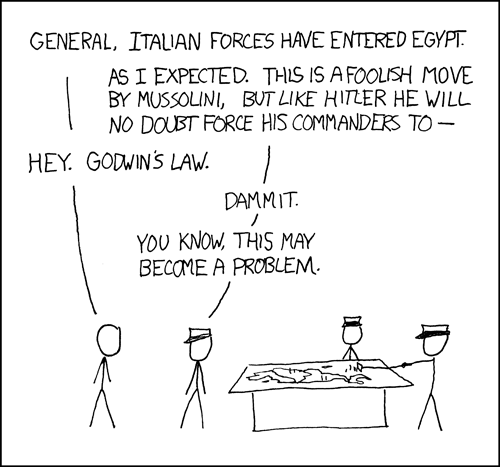
A well-known rule of the internet, Godwin's Law, states that "As an online discussion grows longer, the probability of a comparison involving Nazis or Hitler approaches 1." A corollary to this law, one which I wish were observed more often, is that whoever uses the comparison automatically loses the argument and the discussion must immediately cease:

"Constantly stopping these briefings halfway through is becoming a pain." Source 
There's a paradoxical quality about appeals to Nazism to bolster one's argument. They don't really work because, on the one hand, Nazis were Pure Evil, and on the other, they really weren't that different from you and me at all, dear reader.**

Let me break that down.

1. The Nazis were Pure Evil

The reason comparisons to Nazism don't work as rhetoric is the same reason the words "never" and "always" don't work as rhetoric.

A few years ago, I learned to avoid absolutes in trying to convince someone of something. If say, you're trying to convince someone to change their habit of eating lots of cookies,† telling them "You always eat five cookies when you get home from work" or "You can never seem to keep from eating cookies when you have the chance" is a bad strategy, because all the person has to do is think of one counter-example ("I only ate four cookies when I got home from work on Thursday!") and you're wrong, your argument is suddenly weak, and the person is unlikely to be convinced.

Similarly, comparisons to Nazism are easy to push aside, because everyone knows that the Nazis were just the worst, man, like literally. Since our culture treats Nazism as the absolute height of all evils, and Hitler as the pinnacle and archetype of that evil, comparisons to Nazi ideology or the Fuhrer don't hold much water, because it's easy to find counter-examples and undermine the argument ("Obama isn't just like Hitler; Hitler was a vegetarian!")

2. The Nazis were just some dudes

Some recent reading I've been doing has brought the opposite side of this coin to my attention quite sharply. We treat Nazism and Hitler as radical, ultimate evil, but in reality there's a discomfiting degree of continuity between ourselves and Hitler, between American national ideology and Nazism.

Dale Aukerman's book Darkening Valley: A Biblical Perspective on Nuclear War was recommended recently to me by a friend of my wife (and, I think, a new friend to me also). It initially struck me as an odd topic to read about, but the book's recommender assured me it was worth my time, and he was not wrong.

The project of Darkening Valley is to discuss nuclear war through Bible stories. Each chapter takes a particular story from the Bible and uses it to explain and engage with an element of nuclear war; the opening chapter, for example, uses the story of Cain killing his brother Abel to remind the reader that a tendency toward violence is a deep element of human nature, and then goes on to point out how dangerous that fact is in conjunction with the fact that humans now have the weapons required to destroy themselves nearly instantaneously.

Aukerman touches on Hitler and Nazism often throughout the book, circling round again and again to examine the ways in which the specter of the Nazis has been used to justify war and the threat of war. Most strikingly, in a chapter titled "Hitler and the Woman Caught in Adultery," Aukerman discusses the "dark continuity" between himself and Hitler, between Nazism and the rest of the human race, and uses the story of the woman caught in adultery and brought to Jesus to illustrate his point. I'll quote Aukerman at length here, since he's substantially more eloquent than I am:

I want to challenge the assumption that there is a sharp discontinuity between who we are and who Adolf Hitler was, and the parallel assumption of discontinuity between our particular society and Nazi Germany. It is crucial for us to recognize not only the continuity between the darkness deep in each of us and the darkness in Hitler, but also a continuity between positive impulses and longings within us and those, even if to a large extent atrophied, within Hitler. 
The evidence that substantiates this dark continuity is manifold: many of the experimental findings of contemporary psychological studies of aggression and violence; any introspection which owns up to lethal sentiments, murderous fantasies and racist presumptions within us; the final stages of World War II in Europe during which the Allied nations outdid the Axis powers in unleashing violence; the prevailing popular attitudes in Allied countries toward the Nazis then and now. The attitude that Hitler and those around him were so wicked that they simply had to be done away with, was identical to the darkness that was being combated: a readiness to do away with those seen as enemies, a driving need to annihilate those reckoned unworthy to live.
It is most of all in the scriptural witness that we are shown the nature of this dark continuity...[T]he most revealing passage is...the story of the woman caught in the act of adultery. The Pharisees and the doctors of the law could come as they did because they recognized no continuity between who they had been and were and the publicly exposed adulteress. Jesus, moving to save the woman from execution, sought also to save her accusers from perdition and to bring them to a recognition of this continuity. It may be that most or even all of the accusers had not committed adultery as a physical act. But he who in the Sermon on the Mount probed into the depths from which such acts emerge was doing the same here. He wanted to express to his antagonists that a conspicuous example of wrongdoing, rather than reinforcing an exultant self-righteousness, was to bring awareness of the sin common to all human beings and of the shared need for forgiveness and conversion...  
All the desolation of nature, the razing of cities, the slaughter of millions of human beings carried out by Nazi Germany was only a limited foreshadowing of the desolating, razing, annihilating which the peoples of West and East are prepared to carry out. During years of residence in West Germany, I often wondered how decent, good-hearted Germans could have gone along with Nazism. Some of the answer comes through asking the same question of Americans (including myself at a certain level) and nuclear weapons. There is the drivenness of both those who lead and those who are led; fear of determined adversaries; emptiness within individual and society; the lure of power; the drive to be the center of the universe; the infernal darkness within, which the Dark Powers from without align with themselves. The Yes to nuclear weapons by good-hearted Americans who are distraught by the death of a pet and full of altruism toward neighbors recapitulates that earlier yielding to the Dark Powers by Adolf Hitler and those who moved in concert with him.
Dale Aukerman, Darkening Valley, pgs. 19 and 22, emphasis added 
My point, and Aukerman's point, is not that the Nazis and Hitler were good, or even that they weren't evil. It is simply that when we use the Nazis for rhetorical point scoring, when we hold them up as the highest, purest example of Evil, we miss the opportunity to actually reflect on what Nazism was and to use that reflection for tangible, human good. We miss the chance to see their darkness in ourselves and our neighbors, and to work actively to resist that darkness. We blind ourselves, and we risk a tragic stumble.

*This is a play on a quote from the Big Lebowski.
**I mean, especially if you're a Nazi, dear reader, because I certainly can't tell who you are from this side of the screen. But even if you're not a Nazi, is what I'm saying. Get it? If not, uh, read on, I promise I explain elsewhere outside this footnote.
†It's a hypothetical example. Stop looking at me like that.

Monday, January 6, 2014

The New Testament (in 48 hours)

This is the final entry in a series of posts on Reading the Whole Bible


I'll meet you at the Alamo mission
And we will say our prayers.
The Holy Ghost and the Virgin Mother
Will heal us, as we kneel there,
In the midnight moonlight,
Midnight moonlight, moonlight,
In the midnight, moonlight,
In the midnight moonlight, midnight.
—"Midnight Moonlight," The Be Good Tanyas

How It All Went Down:

At long last, I've come to the end of this project. As I mentioned in an entry this summer, I'd initially thought it would take me about three months to read my Bible, given that there were only 2000 pages or so, and with a good novel I can do 2000 pages in a couple of weeks. 2000 pages of Bible, I reasoned, shouldn't take much more than that. I ended up making quick progress until I hit the ~600 pages of poetry in the middle, which were so different and hard to plow through that I ended up taking a whole month off just to enjoy reading other things; I read much more slowly once I returned to them.

Perhaps surprisingly, I was expecting the same problem with the New Testament.

The New Testament is not my favorite part of the Bible; that designation is reserved for the beautiful narratives of the Hebrew Bible, especially 1 and 2 Samuel. Biblical narrative is what I crave; thankfully, there are five narrative books stacked right at the beginning of the NT: the four gospels (Matthew, Mark, Luke, and John) which depict the life of Jesus from slightly different angles, and Acts, which describes the beginnings of the Christian church as it spread from Israel into the Roman Empire. While these books sometimes don't quite measure up to the sheer narrative artistry and literary pleasures of the Hebrew Bible's greatest moments, they are all still wonderful to read, and examining them in detail with commentary was something I looked forward to. These books were not my problem.

My problem with the New Testament has always been the second half, which consists almost entirely of epistles (a word which I was not able to distinguish from "apostles" until I was almost an adult) or letters. These letters were often sent from a church leader to a specific church in another city, but sometimes to a specific individual or a more general audience, the early Christians as a whole. These books, in other words, do not tell a story; rather, they lay out instructions and theology for the early church, often using the techniques of ancient Greek rhetoric to do so. To say the least, the prospect of ending the Bible project with a slog through ~200 pages of this epistolary material did not seem all that exciting.

To get around this, and the risk of dragging out the project over another month or two, I borrowed a technique I learned in college: set an arbitrary deadline and cram like heck to meet it!

It so happened that by the end of 2013, I had only finished about one and a half gospels, and so had over 300 pages left to finish in the NT before I was done with the Bible. Since I'd made no plans for New Year's Eve, I decided I would try my best to finish before midnight. After I got home from work, I sat down with some snacks and a couple of Bibles for cross-referencing and went to town. I ended up making it about halfway through the remaining 300 pages before midnight, going to sleep, waking up early, and finishing the rest over the course of the next day, finishing just before midnight on New Year's Day, 2014. So if the Whole Bible Project had really been a college assignment, I would have lost a letter grade for turning it in a day late. Still: the arbitrary deadline worked! 300 pages in 2 days was by far the best speed I'd managed to accomplish over the course of the project. The real question was: at that pace, would I get anything meaningful out of it?

What I Got Out of It:

Dude, of course I did. The Bible is awesome; pretty much no matter how fast you read it, you can learn something. As the New Testament book of Hebrews puts it, "the word of God is living and active, sharper than any two-edged sword."

Except, of course, that when you read that verse in context, it's clear that it means nothing of the kind:
Indeed, the word of God is living and active, sharper than any two-edged sword, piercing until it divides soul from spirit, joints from marrow; it is able to judge the thoughts and intentions of the heart. And before him no creature is hidden, but all are naked and laid bare to the eyes of the one to whom we must render an account. (Hebrews 4:12-13, NRSV)
In Hebrews, the verse is clearly referring not to the liveliness and potency of scripture, but to God's ability to speak to and judge the human heart. Yet I have never heard this verse quoted by a Christian except as a way of talking about the Bible, "God's word," as we have come to call it, never mind that the Bible as we know it, for obvious reasons, simply did not exist when the anonymous author of Hebrews was writing.

One of the most interesting parts of reading through the whole NT, then, was putting back into context verses that I'd heard quoted time again in church as prooftexts for some idea or other, discovering in the process that they meant something completely different than I'd been taught. Here's another one, Romans 8:28: "We know that all things work together for good for those who love God" (NRSV). For some reason, this is often quoted as proof that God wills all things, good or bad, and that the bad things he wills are secretly going to work out for the better, which has always struck me as insane. The notion that rapes and murders and catastrophes and wars are God's will is fine, if you don't believe that God is good, but the people who say this stuff do believe that. In context, or heck, even out of context, it seems pretty clear to me that this verse means something radically different; as my commentary so helpfully put it, "[Romans 8:28] does not say that God wills all things, but that God works in all things for the good of those who love God" (New Interpreter's Study Bible, pg. 2022, emphasis mine). It was nice not only to read it as part of a larger whole, but to have the commentary on it confirm my suspicion that it is being misinterpreted.

The slightly disturbing thing about the project was that, even as I was gleefully reading well-known verses and discovering their original meanings, I also watched the Biblical authors do the exact opposite.

The funny thing about the Bible is how self-referential it is. The Biblical authors were constantly quoting, alluding to, or retelling each other's stories and ideas:

Map of all the cross-references in the Bible; color corresponds to textual distance between the points of reference
As the earlier books of the Bible aged, they took on a new character for the Jews (and later Christians) who read them. The most important conclusion that later readers came to was that these books were not just texts written for the specific time and audience of their authors' day, but as universal divine messages to people, and especially messages that were relevant for their own time as later readers. One important result of this was that the books of the Bible that had already been written came to be seen as a kind of vast code, any part of which might be extracted and connected with something else to make a new meaning.

For example: the author of Hebrews, the very book I've already complained about people extracting a single verse from and giving it a whole new meaning, felt extremely free to quote from and allude to the Hebrew Bible throughout his own book; my commentary counts 30 direct citations and 70 allusions. These citations and allusions are not serving the purpose of elucidating what their original authors wanted to say to their own audience; rather, the author of Hebrews is governed by "the conviction that Christ is the ultimate meaning and goal of the [Hebrew Bible] and thus that the [Hebrew Bible] constantly points to him" (NISB, pg. 2152; the original text has "OT," that is "Old Testament," where I've put "Hebrew Bible," but OT is not a term I've been using in writing this series). In keeping with this conviction, the author of Hebrews disregards the original meanings of his texts and read them as if they referred to Christ. 

My feeling of superiority, therefore, was severely undercut by the fact that the same principle I was objecting to seemed to have been applied throughout the very Bible I was trying to protect from it. Wrestling with questions of context and reinterpretation has been a big part of the fun of this project, though, which I've written a bit more about elsewhere. 

What Else: 

The best part of this two-day Bible smorgasbord was finally discovering some actual enjoyment in reading those dreaded epistles. When segments of the epistles are read in church, they often come off as didactic in tone and the kind of un-fun thing you wouldn't really want to dive into at length. When reading in a group at a Bible study, they seem confusing and sometimes even pointless. However, reading them on my own, quickly, with a commentary to guide me, I discovered a couple of delightful things:

The first was that, quite apart from any spiritual meaning I might someday extract from them as pieces of religious instruction, the letters actually double as a sort of sketch of the very early history of the church. These letters, after all, are the first Christian writings we possess, and they make for a sort of historical mystery or puzzle to solve, the prize for solving it being a vision of the structure community and life of the first people to believe in Jesus as we Christians, their spiritual descendants, still do today.

For example, the main thesis of the book of Galatians (so named because early Christian missionary Paul wrote it to a church in the city of Galatia), is that as Christians, we are justified, or known to be righteous, because of our faith in Christ, not because of obedience to religious laws. In articulating this message, though, Paul takes a moment to tell how he confronted the apostle Peter (here called by his Aramaic name, Cephas) when he saw him doing something he thought was wrong:
But when Cephas came to Antioch, I opposed him to his face, because he stood self-condemned; for until certain people came from James, he used to eat with the Gentiles. But after they came, he drew back and kept himself separate for fear of the circumcision faction. And the other Jews joined him in this hypocrisy, so that even Barnabas was led astray by their hypocrisy. But when I saw that they were not acting consistently with the truth of the gospel, I said to Cephas before them all, “If you, though a Jew, live like a Gentile and not like a Jew, how can you compel the Gentiles to live like Jews? (Galatians 2:11-14, NRSV)
The point of the story is that Paul is defending the right of Gentile Christians to not get circumcised (since they were justified by faith in Christ, not obedience to the Jewish religious laws, including the commandment that males must be circumcised). It supports his thesis in the book of Galatians: he has stood up for this idea in his own life, as the story demonstrates. But the result of him telling us the story is that we have this little glimpse of conflict in the early church, between two of its most key founding members: Peter, the most prominent disciple of Christ and a leader of the early church, and Paul, the formulator of much of the early church's theology and the person who most actively spread the faith to non-Jews. These kinds of clues are nearly always left out of church services, because while they are interesting if you're looking for this sideways glimpse of the early church I'm talking about, they tend to leave something to be desired in terms of teaching a religious idea or lesson.

The other delightful thing I discovered in the epistles was the radical, creative, odd beauty of the theology in the letters. When I read these letters, Christianity felt less like something a couple of millennia old, with tradition after tradition and interpretation after reinterpretation stacked against and on top of each other across the ages, and more like something completely fresh and weird, at once full of adventure and joy. Reading the books all in the course of 48 hours helped reinforce this feeling for me, since I was seeing the letters all together and watching the church grow and change and think and even argue with itself over the course of its first few decades. But I think all it really takes to get this feeling is to step away for a moment from the idea that these books are written primarily for you, the reader (an idea which I've found Christians, especially Protestants, seem to assume more often than is healthy) and to instead start by thinking about the original audience. To me, the fact that they are letters, often literally written to a specific, named audience of people, was also helpful in this regard.

At all events, I enjoyed thinking about ideas I'd heard countless times before being articulated for the first time, to the audiences for whom they were originally meant. The newness, the weirdness, the creativity came through powerfully and beautifully for me. As a demonstration, I'd like to return to the book I started this section with, the Letter to the Hebrews. The main point of the book is to articulate the idea that Jesus is the believers' very own High Priest, like the Jewish High Priest who made the atoning sacrifices in the Holy of Holies at the Temple at Jerusalem, only better:
For Christ did not enter a sanctuary made by human hands, a mere copy of the true one, but he entered into heaven itself, now to appear in the presence of God on our behalf. Nor was it to offer himself again and again, as the high priest enters the Holy Place year after year with blood that is not his own; for then he would have had to suffer again and again since the foundation of the world. But as it is, he has appeared once for all at the end of the age to remove sin by the sacrifice of himself. (Hebrews 9:24-25, NRSV, emphasis mine)
The notion that Jesus is a High Priest of some kind or another has been rattling around in my brain for a decade or two, mostly because I often sang this one song that mentions it briefly at the beginning. I've also been aware of the notion that Jesus' sacrifice atones for sins, in the abstract, for a long time. What's neat about this passage is how eloquently, and creatively, it articulates a completely new piece of theology: Jesus is the new High Priest, who made a sacrifice, not of an animal's blood, but of his own, and not for one time only, but for all people and for always.

For Christians today, this idea maybe isn't that big of a deal. But for the Jewish Christians who were the audience for this letter, who were concerned about the religion they'd chosen, facing rejection from their society and religion, and considering leaving the faith, this creative bit of theologizing might have made all the difference. It connected their faith with the faith of their forbears, and assured them that they had chosen the correct way, that they were still part of God's people.

The fact that the Biblical authors were able to draw together the different strands of their faith, different ideas from previous generations, into something new that spoke to their own day, gives me hope that I and my fellow Christians can do the same in our time. While I may sometimes worry about people forgetting the context for the verses they quote as proof to each other, in the end I am encouraged by the examples I found in the New Testament, especially in the epistles, and I believe that God can still speak to us through the fresh reading and application of these ancient texts.


Photo Sources:
http://www.chrisharrison.net/index.php/Visualizations/BibleViz
https://secure.flickr.com/photos/29811338@N05/3601180188/

Monday, December 16, 2013

Reading the Apocrypha

Part of a series on Reading the Whole Bible
Orthodox priest studying his Bible, which contains the Apocrypha
So take to the streets with your apocalypse strain,
Your devotion has the look of a lunatic's gaze.
—"Apocalypse Song," St. Vincent

 A couple months ago I finished the Hebrew Bible and started work on the Apocrypha, a group of books that form the middle section of my NRSV Bible. The books in this section weigh in at a relatively svelte 350 pages or so in my Bible, compared to the great and honking mass that is the Hebrew Bible at 1300 pages.

The Apocrypha are not a separate section in Catholic or Orthodox Bibles; you will find the books that are gathered under that name in my NRSV scattered throughout a Catholic or Orthodox volume. And a typical Protestant Bible will exclude them altogether: as a Protestant myself, no Bible I ever saw in church growing up had these books, and it wasn't until my parents thoughtfully gave me a New Interpreter's Study Bible* for my college graduation present (yes, I was then and am still a Bible nerd) that I finally came to own a Bible that included them. To understand why this is so, we need to dig into a little history.

A Short History of the Apocrypha:

In the three centuries before Jesus' life on earth, the Jews lived not only in their homeland of Palestine but also in communities scattered around the ancient Near East, especially in Alexandria, Egypt. They were a part of the first Jewish diaspora into the larger ancient world. The language of their daily lives ceased to be Hebrew, in favor of the Greek that their neighbors spoke. (This was especially true of Jews living outside of Palestine. In Palestine, on the other hand, many Jews, including Jesus, came to speak Aramaic as their primary language.**)

The Hebrew Bible was translated into Greek for the benefit of this diaspora community. (The most popular ancient Greek translation was called the Septuagint, though there were others.) Meanwhile, religious books were still being composed by Jews in these last three centuries BCE; they were sometimes composed in Hebrew, sometimes in Greek, but were usually translated and circulated in Greek if they hadn't been written in it, and most copies of the book in existence at any given time would have been in Greek. The most popular of these books took on as much significance as the older books of the Hebrew Bible for many ancient Jews, and the distinction between these newer books and their older counterparts might not have been as clear as one might think. To quote my Bible's notes on the subject, "For a Greek-speaking Jew living in Egypt, it would have been far from clear that (for example) Proverbs, which he or she would know in its Greek version, was Holy Scripture, whereas the (rather similar) Wisdom of Solomon, which was originally composed in Greek, was not" (Access Bible, pg. 32).

This means that, in Jesus' day, there was a sort of unofficial Jewish canon of scripture that included both the older books that we now know as the Hebrew Bible, and some newer books either written Greek in or primarily known in their Greek translations. When Christianity formed, it inherited this larger canon of Jewish scripture. Later, as modern Judaism began to form under the rabbis who led the Jewish community after the destruction of the Temple, Jews began to consider only the books in Hebrew as canonical.

So, somewhat ironically, Christians ended up preserving quite a number of ancient Jewish writings that would likely have been lost otherwise. There was some dissent about these books among Christians in ancient times, who noticed that the Jews had a smaller canon that only included the older Hebrew works,† but for the most part, other Christians paid little attention to this dissent. But all this doesn't quite explain how I, a Protestant, ended up never getting around to reading the Apocrypha until this year. For that, we need to jump forward to the Reformation.

Depiction of St. Jerome, ancient translator who objected to the Apocrypha

In the sixteenth century, a number of religious thinkers and leaders called for changes in the Roman Catholic Church, were denounced and expelled as heretics, and ended up forming their own church movements as a result. This period is called the Protestant Reformation (which has always struck me as slightly odd, since the people who protested and left the Catholic Church did not really succeed in reforming it, though the Catholics eventually got around to making some of the changes the Protestant Reformers suggested anyway, in a movement amusingly titled the Counter-Reformation). One of the most important ideas of the Reformation was something called sola scriptura, which is a doctrine that the Bible contains everything you need to know in order to be saved from sin and hell, and therefore that only ideas that are directly stated in the Bible (or that can be logically derived from statements in the Bible) should be considered doctrines of the church.

In enunciating the rallying cry of sola scriptura, the Reformers began to examine the contents and extent of said scriptura in more detail than was common at the time. They ended up agreeing with the earlier Christian thinkers who had wanted to remove the books from the canon.‡ While early Protestant translations of the Bible, including the still-widely-loved King James Version, kept the books as a separate section between the Old and New Testaments, the Apocrypha quickly fell out of favor (from what I can tell, many Protestants considered them "too Catholic," but I can also see how it might be annoying and weird to have some books in your Bible that aren't, you know, scripture), and most Protestant Bibles that are produced today, KJVs included, do not include the Apocrypha. Protestants working on new translations have generally not even bothered to translate them.

Title page from a Counter-Reformation Bible

Thankfully, the good folks who created the (somewhat redundant-sounding) New Revised Standard Version did bother to translate the Apocryphal books, and they are included in both of the NRSV volumes that I own. (Perhaps unsurprisingly, most NRSVs used by Protestant churches do not include the Apocrypha. There's also a Catholic NRSV edition that includes the books in the order they appear in in Catholic Bibles.) The NRSV Apocrypha section includes not only the books that appear in Catholic Bibles, but also some that appear only in Orthodox Bibles.

Reading the Apocrypha:

As I've remarked before, I have way more love for Biblical narrative than for other Biblical genres; I'm especially bad at enjoying or understanding Biblical poetry, at least at any length. Unfortunately for me, two of the longest books in the Apocrypha, the Wisdom of Solomon and the book of Sirach, are books of poetry. Wisdom was pretty good; it's the shorter of the two, and I enjoyed its message of the importance of pursuing goodness and righteousness, even in the face of opposition. Sirach was a doozy though; not only is it the longest Apocryphal book by far (51 chapters and 87 pages in my Bible, while no other book in the section gets much beyond 50 pages), it's also not very fun or interesting, and it's littered with the most entrenched patriarchy/misogyny I've seen pretty much anywhere in the Bible, which is not the most forward-thinking, when it comes to gender, on a good day. Take this gem, Sirach 42:12: Better is the wickedness of a man than a woman who does good; it is woman who brings shame and disgrace. "The severity of this statement," my Bible commentary notes, "is unparalleled in Biblical literature." Blerg.

Much of the other material in this section is a lot better than this, though, and in fact one book, Judith, is practically a proto-feminist text. The main character of this short novel is Judith, a strong, independent widow who saves her town from an invading army by tricking her way into the general's quarters and beheading him. I love its positive vision of service to God and people, although I suppose its violent resolution is not necessarily my favorite thing in the world. It's quite well written, however, doing a great job of building suspense and creating a sense of danger for the heroine before she completes her grisly mission.

And boy, is it grisly

I once read somewhere that ancient authors thought it was important to avoid creating suspense because it distracted the audience from the point of the story. If this is true, then whoever wrote the book of Tobit must have subscribed to this ancient literary theory. Tobit is a really fun, edifying, and satisfying story, but the funniest moment in it for me is when, about three chapters in, the author steps aside from narrating the story itself to assure the reader that everything is going to turn out okay for the main characters. (Second funniest moment: Tobit 6:3, which says, "Suddenly a large fish leaped up from the water and tried to swallow the young man’s foot, and he cried out." Hee hee.) The book is the story of a man, Tobit, and his son, Tobias. Tobit is a pretty cool guy, but early in the story becomes blind and impoverished, and God sends an angel to help Tobias on a journey to retrieve some money for his dad. Along the way, Tobias saves a woman from a demon that's been keeping her from getting married, and then marries her (the woman, not the demon). The book places a weirdly strong emphasis on the importance of properly burying the dead, and I found it mildly unsettling that the angel in the story feels the need to repeatedly lie to conceal the fact that he's an angel, but these are both things that actually added to the fun for me in discovering this new book. 

Other fun stuff in the Apocrypha included the various books called "Maccabees;" 1 and 2 Maccabees, for example, are actually two different authors' perspectives on the same period in history. I have next to no exposure to said time period, the era when the Jews rebelled against their Greek overlords and set up an independent state of Israel (which lasted for over a century, until it was conquered and incorporated as a Roman province; sigh). "Maccabees" is the nickname for the family that led this rebellion, and of one member, Judas Maccabeus (or "Judah Maccabee"), in particular; the nickname probably has something to do with the Aramaic word for "hammer," though apparently there are other theories.

Judah Maccabee leading his army

Amusingly, neither 3 Maccabees nor 4 Maccabees has anyone from Judah Maccabee's family in it, though they both involve roughly the same period in Jewish history as 1 and 2 Maccabees. 3 Maccabees is delightful mostly for the deliciously weird irony of its premise. At the start of the book, the king of Egypt, Ptolemy, is saved from death by a Jew. To show his gratitude, the king offers a sacrifice at the Temple in Jerusalem; once there, however, he is enraged to discover that he is absolutely forbidden to enter the Holy of Holies, where even the high priest is allowed only once a year, and so the king resolves to kill all the Jews in Egypt out of spite. Much hilarity ensues, including several (failed) attempts to trample the Jews to death with elephants, and the king ends up blaming the idea for the whole episode on his advisers when he finally repents in the face of an angelic intervention. 4 Maccabees is a philosophical treatise that sets out to prove that reason can govern the emotions, but it is taken up in very large part with an unnecessarily detailed account of King Antiochus torturing seven Jewish brothers and their mother to death (an event which 2 Maccabees records with slightly more decorum as part of a general campaign by the King Antiochus to snuff out the Jewish way of life, which eventually led to the Maccabean revolt). Neither 3 nor 4 Maccabees can be found in Catholic Bibles, and 4 Maccabees is scarcely in any Orthodox ones either, but I was certainly happy the NRSV translators included them, especially 3 Maccabees, which is a riot.

Several books of the Hebrew Bible appeared in expanded form when translated into Greek; these Greek additions are listed among the Apocrypha, but are mostly too short to give much attention to on their own, though one addition to Daniel, Bel and the Dragon, is kind of cool because it has a dragon. The Letter of Jeremiah is an addition to the Hebrew Bible book of Jeremiah, and it's pretty much dedicated entirely to the questionable Biblical argument that idols should not be worshiped because they are man-made. This made it a lovely example when I needed to wrap up a post about idolatry a few weeks ago.

My favorite book in the Apocrypha was 2 Esdras, which only appears in the Slavonic Bible (one of the Bibles of the Orthodox churches), and Jerome's Latin translation of the Bible, the Vulgate (where it appears as an appendix). The Wikipedia entry on 2 Esdras calls it "one of the gems of Jewish apocalyptic literature," which I think sums it up rather nicely. The book is a collection of several authors' viewpoints on the chaotic and troubling goings-on of the early centuries CE, but my favorite is the middle section, which depicts a dialog between the main character, Ezra, and the angel Uriel, who God sends to comfort Ezra in his distress and answer his questions about the end of the world and the life to come. In particular, I identify with Ezra's questions about the nature of the afterlife, especially his outraged inquiry, repeated throughout the book: why is it that most people who live will not go to heaven, but will suffer in the afterlife? Ezra several times rejects the angel Uriel's too-pat answers to this very important question, and while Ezra eventually comes round to Uriel's way of thinking, a number of unanswered questions remain, which is how I like my Biblical books. 2 Esdras reminds me of nothing else in the Bible so much as Abraham's argument with God, in which he attempts to save the cities of Sodom and Gomorrah for the sake of the few righteous people who live there. This argument between God and Abraham is one of the pivotal moments in the book of Genesis and in Jewish thought on the nature of God, and 2 Esdras expands on it and plays with it and many other Biblical scenes and tropes, to good effect. I'm glad I have a Bible with this book in it, and the others I've talked about; I hope to revisit them again sometime soon.


*The NISB is a great book, and I've been using it to supplement my reading, especially when I'm reading at home in the evenings. It's not very portable, though; thankfully, as I mention briefly in the first post in this series, my father was kind enough to get me a copy of the more obscure but quite good Access Bible, which has provided enough commentary to keep me engaged and make sure I'm understanding what's going on in some of the more obscure places. It has significantly less commentary than the NISB, though, and it's a paperback to boot, so I can take it with me from place to place without totally hulking out and frightening passersby with my unbridled physical prowess.
**Aramaic is a language related to Hebrew; it was the language of the Babylonians, who destroyed the ancient nation of Judah and carried many Jews into exile in Babylon. This is roughly how it replaced Hebrew for the Jews in Palestine: not only would the Jews in exile have used Aramaic in their daily lives, and would have brought it with them when they returned to their ancestral home a generation later, but also the people who stayed behind in Palestine became part of the Babylonian Empire, an Aramaic-speaking empire, and would have needed Aramaic for administrative and other purposes.
†These included St. Jerome, who learned enough Hebrew from his Jewish friends to translate the Bible into Latin (in what became known as the Vulgate, which is still in use by the Catholic Church). In doing so, he found out that they had a smaller canon and objected to the inclusion of the books that the Jews had not included in their Bibles into his Old Testament, even going so far as to get into a debate with St. Augustine on the subject. He ended up translating them in spite of his objections.
‡The Reformers had varying views of the works in the Apocrypha; Luther thought that, though they were not to be considered scripture, the Apocryphal books were still good and valuable, and he said wanted them to be read and taught by Christians. Calvin had a much more pessimistic view, though even he was not entirely consistent on the matter. From what I can tell, the Anabaptist Reformers generally thought of these books quite positively and may even have thought of them as authoritative scripture, though like other Protestant movements, modern Anabaptist churches have generally excluded them from their Bibles.

Photo sources:
http://commons.wikimedia.org/wiki/File:Orthodox_Priest,_Tek_Teklay,_Ethiopia_%288070187014%29.jpg
http://commons.wikimedia.org/wiki/File:Workshop_of_Pieter_Coecke_van_Aelst,_the_elder_-_Saint_Jerome_in_His_Study_-_Walters_37256.jpg
http://commons.wikimedia.org/wiki/File:Johannes_Eck_1537_Titel.jpg
http://en.wikipedia.org/wiki/File:GENTILESCHI_Judith.jpg
http://commons.wikimedia.org/wiki/File:143.Judas_Maccabeus_Pursues_Timotheus.jpg

Monday, November 18, 2013

1 & 2 Samuel: The Hebrew Bible's Best Novel

David's Grief over Absalom, Illustration from a Bible Card

And I should have known that my son so bold,
He'd bear my sword, he'd take my sword,
He'd take my sword to his grave.

—"Absalom," Families

Yesterday, my fiancée and I were asked to present our favorite scriptures to a Sunday school class we were participating in. After a little thought, she had come up with several lovely bits from the book of Matthew, things like "can any of you by worrying add a single hour to his life?" and "ask and it shall be given to you." I, meanwhile, was having much more trouble thinking of something to present. Not because I don't have favorite scriptures, but because I tend to think of them in terms of whole books, rather than individual verses from those books.

For the purposes of the Sunday school lesson, this was about as helpful as being asked my favorite movie quote and responding by acting out the entirety of Children of Men. I at least knew what my favorite book of the Bible was, though, so I had a decent starting place to start thinking on the question.

1 and 2 Samuel is my favorite book in the Bible. (In Bibles today, it's divided up into two books, 1 Samuel and 2 Samuel, but that's because when it was translated from Hebrew to Greek in ancient times, the Greek text was too long to fit on a single scroll, so it was split up into two scrolls. It's all one book, though!*) Broadly speaking, it's the story of how the ancient people of Israel went from being a hodgepodge of tribes with local rulers, often oppressed and attacked by neighboring tribes and peoples, to a unified nation under a single ruler, strong enough to defend itself adequately and play a role on the world stage of its era. But really, 1 and 2 Samuel is the story of one man: King David.

Samuel is interesting for a lot of reasons, but to me, it's the story of the ruthless rise to power and gradual aging and decline of King David that's the most fascinating. (There are other people's stories in it, including the story of the prophet Samuel, who the book is named for. These stories serve as a sort of lead-in to the main narrative about David.) Not just the story, though: while the plot of 1 and 2 Samuel is quite intriguing, it's the way the author** uses the literary tools at his disposal to portray that story that's truly compelling. Not only does the author present the history of David's life in a compelling way, he also uses the story to grapple with and explore big questions and problems in the human condition, on topics as diverse as aging, death, necessary evils, fame, political machinations, lust, avarice, treachery, murder, and, uh, hemorrhoids.

David and Goliath (Caravaggio) maybe the most famous image of David where he's not naked

Take this for an example: one of the basic tools the authors of the Hebrew Bible used to quickly define their characters was to make the first words a character says a key to understanding him or her. In 1 Samuel, David's first line of dialog takes place during the story of Goliath, a giant Philistine who has challenged the Israelite army to send a champion to fight him, and insulted them and their God when they do not immediately send someone. When David hears Goliath's challenge, he speaks for the first time:
"What shall be done for the man who kills this Philistine, and takes away the reproach from Israel? For who is this uncircumcised Philistine that he should defy the armies of the living God?" (1 Samuel 17:26, NRSV)
The first thing David ever says in 1 and 2 Samuel (1) looks very pointedly for (political) gain—the answer to "What shall be done for the man...?" turns out to be "You get to marry the king's daughter!"—and (2) either balances out or, more likely, covers up this grab for personal profit with some pious, patriotic rhetoric. This ends up being key to the author's portrayal of David, a character who uses whatever means necessary to gain and consolidate political power, and then either makes up for it or covers it up (depending on how charitable you want to be as a reader) with expressions of piety and political necessity.

Combat between Soldiers of Ish-Bosheth and David (Gustave Doré)

I'd like to take an aside to defend the use of the word "novel" to describe1 and 2 Samuel. The author of 1 and 2 Samuel has a clear interest in depicting historical events; unlike, say, Job or Jonah, 1 and 2 Samuel does not appear to have been made up out of whole cloth for purposes other than communicating historical events. (Whether David and the other characters of the book are real historical figures has been debated, but 1 and 2 Samuel lacks characteristics one would expect of a portrait of a legendary figure, and it is certainly no fable or morality play.) Even though 1 and 2 Samuel is interested in history, it is not just a book of history; the author feels free to incorporate folk tales and legends into the work, as well as other fictional elements. Literary critic and Bible translator Robert Alter describes it this way:
This narrative...has many signs of what we would call fictional shaping—interior monologues, dialogues between the historical personages in circumstances where there could have been no witnesses to what was said, pointed allusions in the turns of dialogue as well as in the narrative details to Genesis, Joshua, and Judges. What we have in this great story...is not merely a report of history but an imagining of history that is analogous to what Shakespeare did with historical figures and events in his history plays. That is, the known general contours of the historical events and of the principal players are not tampered with, but the writer brings to bear the resources of his literary art in order to imagine deeply, and critically, the concrete moral and emotional predicaments of living in history, in the political realm. To this end, the writer feels free to invent an inner language for the characters, to give their dialogues revelatory shape, to weave together episodes and characters with a fine mesh of recurrent motifs and phrases and analogies of incident, and to define the meaning of the events through metaphor, allusion, and symbol. The writer does all this not to fabricate history but in order to understand it. (The David Story, pgs. xvii-xviii, emphasis added)
Taking historical facts and weaving them together with imagined events, thoughts, and speech in order to wrestle with both the history itself and the themes it represents seems less like history to me than a historical novel. There are other other novels in the Hebrew Bible, stories that follow the arc of a few characters through a plot, not straying far into straight history or poetry or other genres; Jonah is one, and Esther and Ruth. For my money, though, 1 and 2 Samuel is the Hebrew Bible's finest novel, for no other Biblical book can match it for artistry, depth, and sheer enjoyability.

Study of King David (Julia Margaret Cameron)

When it came time on Sunday for me to share my favorite scriptures with the Sunday school class, I chose my favorite moment in 1 and 2 Samuel. It's a little dark, but bear with me:
The Lord struck the child that Uriah's wife bore to David, and it became very ill. David therefore pleaded with God for the child; David fasted, and went in and lay all night on the ground. The elders of his house stood beside him, urging him to rise from the ground; but he would not, nor did he eat food with them. On the seventh day the child died. And the servants of David were afraid to tell him that the child was dead; for they said, "While the child was still alive, we spoke to him, and he did not listen to us; how then can we tell him the child is dead? He may do himself some harm." But when David saw that his servants were whispering together, he perceived that the child was dead; and David said to his servants, "Is the child dead?" They said, "He is dead."
Then David rose from the ground, washed, anointed himself, and changed his clothes. He went into the house of the Lord, and worshiped; he then went to his own house; and when he asked, they set food before him and he ate. Then his servants said to him, "What is this thing that you have done? You fasted and wept for the child while it was alive; but when the child died, you rose and ate food." He said, "While the child was still alive, I fasted and wept; for I said, 'Who knows? The Lord may be gracious to me, and the child may live.' But now he is dead; why should I fast? Can I bring him back again? I shall go to him, but he will not return to me." (2 Samuel 12:15b-24, NRSV)
This story, particularly David's line at the end, is a turning point for his character. Before this incident, David is almost constantly gaining and consolidating political power, and nearly everything he says can be construed as having a secondary, political motive behind it. The heartfelt, wrenching line "Can I bring him back again? I shall go to him, but he will not return to me" is the first time David feels completely real to the reader; his heart is laid bare.

After this point, David begins to turn into the old man he will be at the end of the book, shivering in bed and scarcely aware of what is going on in his kingdom. Along the way, he starts losing track of what is going on in his own household; his children end up violating and murdering each other, and one of them, Absalom, starts a rebellion against David, only to eventually be killed when David takes back the throne, much to David's sorrow.

1 and 2 Samuel is many things, but it is not least a moving portrait of an individual human life, conveyed with profound artistry and richness. I recommend it to any reader looking for such a portrait. For the general reader, it's hard to go wrong with Robert Alter's translation, The David Story, which I quoted earlier. It includes enough helpful commentary to both understand the ancient context and appreciate the artistry of the book without overwhelming the reader, and I highly recommend it.


*It's actually slightly more complicated than this: the end of the book, in which David is on his deathbed and giving his last instructions to Solomon, was later cut off and added to the book of 1 Kings, in order to serve as an introduction to 1 Kings' stories about Solomon. Thus, in modern Bibles, the story of 1 and 2 Samuel really goes all the way through 1 Kings chapter 2.
**The author is anonymous, like most of the authors of the Bible, especially outside the prophetic books, which tend to have been written by the people they're named for, with a number of exceptions. Given the time and place in which 1 and 2 Samuel was written, the author was almost certainly male.

Photo sources:
Photo 1: https://commons.wikimedia.org/wiki/File:David_and_Goliath_by_Caravaggio.jpg
Photo 2: https://commons.wikimedia.org/wiki/File:David%27s_Grief_Over_Absolom_%28Bible_Card%29.jpg
Photo 3: https://commons.wikimedia.org/wiki/File:078.Combat_between_Soldiers_of_Ish-bosheth_and_David.jpg
Photo 4: https://commons.wikimedia.org/wiki/File:Study_of_King_David,_by_Julia_Margaret_Cameron.jpg

Monday, September 30, 2013

I Just Finished Reading the Hebrew Bible

Part of a series on Reading the Whole Bible.

John Martin, "The Destruction of Sodom and Gomorrah." It's going to be that kind of post.

And blood
bitterness
exploding fire
wailing blood
and bleeding
—"Dread Beat and Blood," Linton Kwesi Johnson

This week, I finished reading the Hebrew Bible (AKA The Old Testament—I will stick with the "Hebrew Bible" here and abbreviate it "HB" when I feel like it). And I'm here to tell you why it was scary, weird, surprising, and delightful. In that order.


SCARY:

You've probably heard this before; (heck, I've already mentioned it in the course of this project), but the God of the Hebrew Bible is often portrayed as a violent, seemingly capricious entity. I discovered, though, that there's another layer of scary unpleasantness in the HB, and that comes out of the incredible bitterness and anger that the Biblical authors felt in reaction to the destruction of their country.

There's a fair amount of material generated because of these feelings. Some of it is (in)famous, like the notorious baby-smashing impulse expressed by the Psalmist in Psalm 137, a lament over the destruction of Jerusalem by the Babylonians.

But sometimes this material is the stuff of entire books, and obscure books at that. Obadiah, for example, is one long tirade against the nation of Edom for how they responded when Jerusalen was sacked (basically, they were total dicks about it). It's only a couple pages long, but they're a couple pages of condemnation and divine threats to a whole country of people. Nahum is a book entirely about gloating over the destruction of Nineveh, the capital Israel and Judah's longtime frenemy Assyria. To be fair, the Assyrians were also kind of a bunch of dicks—among other things, they destroyed Israel and took her people away into exile—but Nahum is just page after page of creepy happiness over the death and destruction of an enemy. Which was scary to find in my Bible.

The way I've been processing this strain of scary in the HB* has been to chalk it up to basic, human emotion. I'm sure if someone destroyed the place where I lived and took a bunch of people away, I'd be pretty irate too. I don't know if I'd be baby-smashing irate, but still. It's been easier to figure this stuff out than the whole violent, capricious God thing. On that score, I'm still befuddled and still sympathize more than I probably should with Marcion.


WEIRD:

The Hebrew Bible is a product of an ancient and incredibly foreign culture. This isn't always obvious, because we can read it in our own language and because it's a familiar and even foundational document in our culture. But there are moments when the reader gets jarred out of a sense of familiarity by the appearance of totally alien cultural norms and activities in the Bible. My favorite of these is the symbolic prophetic act.

Raphael, "The Prophets Hosea and Jonah"
Many of the prophets felt called by God to deliver unpopular messages to God's people. And sometimes, they used symbolic, public actions to help them. In our culture, such symbolic acts might take the form of, say, chaining yourself to the White House's front gate, or speaking for 21 hours straight on the Senate floor. In a Biblical setting, things can get a lot weirder than that:
When the Lord first spoke through Hosea, the Lord said to Hosea, “Go, take for yourself a wife of whoredom and have children of whoredom, for the land commits great whoredom by forsaking the Lord.”  So he went and took Gomer daughter of Diblaim, and she conceived and bore him a son. (Hosea 1:2-3, NRSV)
That's right, ladies and gentlemen: Hosea's symbolic act was literally marrying a prostitute. Which is insane.

More awesomely weird is my personal favorite symbolic prophetic act, from Jeremiah:
Thus said the Lord to me, “Go and buy yourself a linen loincloth, and put it on your loins, but do not dip it in water.” So I bought a loincloth according to the word of the Lord, and put it on my loins. And the word of the Lord came to me a second time, saying, “Take the loincloth that you bought and are wearing, and go now to the Euphrates, and hide it there in a cleft of the rock.” So I went, and hid it by the Euphrates, as the Lord commanded me. And after many days the Lord said to me, “Go now to the Euphrates, and take from there the loincloth that I commanded you to hide there.” Then I went to the Euphrates, and dug, and I took the loincloth from the place where I had hidden it. But now the loincloth was ruined; it was good for nothing.

Then the word of the Lord came to me:  Thus says the Lord: Just so I will ruin the pride of Judah and the great pride of Jerusalem. (Jeremiah 13:1-8, NRSV)
Jeremiah's symbolic act involves—yes, it's true!—his dirty, filthy underwear. It's a metaphor, sure, but it's a weird metaphor.

There's plenty of even weirder and crazier stuff in the HB; I won't tell you all about it here for the sake of space, but I just want to point out that the beginning of Ezekiel sounds suspiciously like a UFO sighting and that—and I cannot emphasize this enough—there are talking horses in Zechariah, in addition to a huge flying scroll and a woman sitting in a giant basket for no obvious reason. The Hebrew Bible is weird.


SURPRISING:

There are some real surprises and even delights in reading the Hebrew Bible, though. My biggest surprise came when reading the book of Amos; God shows Amos a vision of some fruit, which seems innocent enough, and then things take a sudden bewildering turn:
This is what the Lord God showed me—a basket of summer fruit. He said, “Amos, what do you see?” And I said, “A basket of summer fruit.”

Then the Lord said to me, “The end has come upon my people Israel; I will never again pass them by. The songs of the temple shall become wailings in that day,” says the Lord God; “the dead bodies shall be many, cast out in every place. Be silent!” (Amos 8:1-3, NRSV)
I found this so jarring that I laughed aloud when I read it. "Hey, God," I thought, "it's just fruit. No need to get so worked up."

The Prophet Amos in a Russian Orthodox Icon
Turns out, there's a pun here: the words for "summer fruit" and "end" sound very similar, and God uses the odd vision of the summer fruit to introduce the idea that follows. Most folks are unaware that puns are a feature of the Hebrew Bible, but they are. It's rarely more obvious than this jarring passage, which simply does not work as a piece of coherent writing unless you know there's a pun. Most of the time, wordplay passes completely unremarked upon in English translations, because it's not central to a clear understanding of the text.

Nevertheless, puns and other wordplay are common tools for the Biblical authors, used for making meaningful connections between passages, carrying ideas forward, and even creating humor. It's too bad modern readers, myself included, are typically not in on the joke.


DELIGHTFUL:

The truly great joy for me, of course, has been in discovering the connections between obscure parts of the Hebrew Bible and the New Testament passages that I know well. It's a pleasure to watch the Biblical authors borrow from and build on each other.

Rafael, "The Prophet Isaiah"
I discovered, for example, that a line I'm used to seeing in hymns is actually not only Biblical but has a more involved history than I might have imagined. Paul uses an image in talking about spreading the gospel, "how beautiful are the feet of those who bring good news," which he appears to have borrowed from Isaiah, who was talking about the hope of Israel being delivered from her enemies. Isaiah, in turn, borrowed it from Nahum, who was talking about how totally rad it was that Judah wasn't going to have to deal with Assyria anymore. Isn't intertextuality fun?

The Hebrew Bible, for all its flaws, was the Bible of Jesus, so it's been worth examining as a Christian to gain insight into his thoughts and what he said and did. In the course of my study of the HB, for example, I read a great essay on Ezekiel and how it relates to the New Testament. I'd never heard of most of the connections between Ezekiel and the NT before, and it was fascinating to me.


SUMMING UP:

Knowing and understanding the Hebrew Bible is essential for Christians, I think. Without its foundational stories, the New Testament can't happen. Without its prophetic messages, the dramatic foreshadowing of the New Testament isn't there. And without its poetic images, the vividness and deep meaning in the New Testament is sucked dry.

While many Christians, myself included, would be more comfortable ignoring the ugliness here in the Hebrew Bible, it is vital to the truth and wholeness of our faith that we find ways to acknowledge and set aside this ugliness and instead learn to seek out the beauty and the truth in it.


*This kind of scary stuff is mostly in the poetic books. The historical books of the Bible, which are clustered in the first third of the Christian Old Testament (the Hebrew Bible has a different order), generally deal with the pain of the destruction of Jerusalem and the subsequent exile by looking for reasons that they might have happened. The typical answer is simply "idolatry."

Photo Sources: 
Photo 1: http://en.wikipedia.org/wiki/File:John_Martin_-_Sodom_and_Gomorrah.jpg
Photo 2: http://commons.wikimedia.org/wiki/File:Raphael_-_The_Prophets_Hosea_and_Jonah_-_Google_Art_Project.jpg 
Photo 3: http://commons.wikimedia.org/wiki/File:Amos-prophet.jpg
Photo 4: http://en.wikipedia.org/wiki/File:Raffaello,_profeta_isaia.jpg